Two-Wheel Wheelbarrow or Garden Cart? Answer These 3 Questions First
Heads up: some links below are affiliate links. GardenVerdict earns a small commission on qualifying purchases, at no extra cost to you.
Heads up: GardenVerdict earns a small commission on purchases made through links in this article, at no cost to you.
Somewhere between “I need to haul this mulch” and “why does my back hurt” is a wheelbarrow decision most people overthink. Two wheels versus one, cart versus barrow, plastic versus steel — the options multiply fast.
Fair warning upfront: community discussion on this specific category is thin. We found limited independent reviews and no meaningful Reddit gardening data to draw from for this guide. What we do have is a solid framework for making the right call, a first-look at one plastic two-wheel barrow, and a detailed look at how the Gorilla Cart stacks up as an alternative for larger properties. If you want deep crowd-sourced reviews, r/gardening and r/homesteading threads on wheelbarrows are worth a browse before buying.
With that caveat out of the way — here’s how to think through it.
The 3 Questions That Actually Matter
1. How hilly is your property?
This is the fork in the road. A traditional single-wheel barrow on a slope is a workout — you’re constantly fighting balance while your arms carry the full load. Two-wheel designs and cart-style haulers distribute that effort dramatically. One reviewer who switched to a cart said it plainly: “Using a wheelbarrow, when you have to go up and down a couple hundred yards up and down a hill, it’s going to wear you out really fast.” On flat ground, a single-wheel barrow is perfectly manageable and maneuvers into tighter spots. On anything sloped, you’ll appreciate the stability of two contact points.
2. What are you hauling — and how much?
Plastic-tray wheelbarrows are genuinely light-duty. They’re good for bagged mulch, potting soil, leaves, and general light garden cleanup. A reviewer of one plastic model put it honestly: “We’re not going to use it for big things here on the farm. We’re going to be using it for smaller things.” If you’re moving gravel, wet concrete, or heavy loads of soil regularly, you want a steel tray or a cart rated for real weight. The Gorilla Cart medium model, for instance, is rated to 1,200 lbs — a different category entirely.
3. How do you need to dump?
Traditional wheelbarrows tip forward with momentum — you’ve got two hands on the handles and gravity does most of the work once you get the nose down. Carts require you to lift the loaded bed with one hand to dump, which gets difficult at capacity. If precise dumping into a planting bed or tight spot matters to you, a barrow’s forward-tip motion is more controlled.
Option 1: The Plastic Two-Wheel Garden Barrow

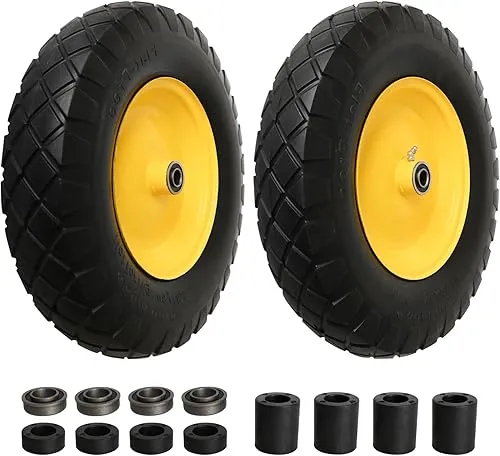
For the light-duty suburban gardener, a two-wheel plastic barrow is a reasonable buy. The model we looked at features 400x8 pneumatic tires — the kind described as heavy-duty and mud-capable — rubber grip handles, and a steel frame with a plastic tray. Assembly runs about 20-30 minutes and is genuinely DIY-friendly.
The two-wheel stance is the real selling point over a traditional single-wheel barrow: it sits stable when you set it down, and you don’t have to hold it upright while loading. On flat to moderately uneven terrain, this makes the whole job less tiring.
What it’s not: a workhorse. The plastic tray is the ceiling here. Bags of mulch? Fine. Compost? Sure. River rock or construction material? Pass.
Good for: Small to medium yards, seasonal garden cleanup, moving bagged or loose soil and mulch, anyone who wants stability without the weight of a steel barrow.
Option 2: The Gorilla Cart (If Your Property Demands It)
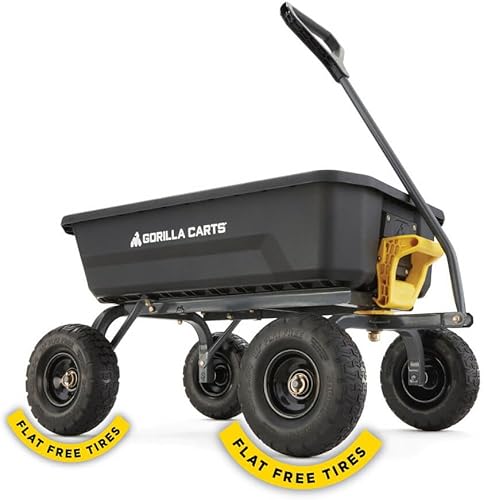
The Gorilla Cart isn’t a wheelbarrow — it’s a four-wheel garden wagon, and it’s worth including here because for certain use cases, it outclasses everything with two wheels. If you have a large property, regular heavy hauling, or a lawn tractor, this is the conversation.
The core advantage is that you drag it rather than balance it. No lifting, no tipping-while-full risk, no arm fatigue on long runs. The medium model’s convertible handle attaches to a lawn tractor, turning it into a towable trailer. That’s a different tool category than a barrow, but one that solves the same fundamental problem.
The trade-offs are real. It never empties fully — residue sticks to the flat bottom and you’ll need a rake to clear it out. Dumping the loaded bed requires lifting it one-handed, which is harder than it sounds at capacity. And it’s larger, so it won’t navigate through a garden gate that a wheelbarrow would fit through easily.
Good for: Large yards, hilly terrain, homeowners with a lawn tractor, anyone moving mulch or wood chips over long distances regularly.
Quick Comparison
| Plastic Two-Wheel Barrow | Gorilla Cart (Medium) | |
|---|---|---|
| Wheel config | 2-wheel | 4-wheel cart |
| Max load | Light-duty | ~1,200 lbs |
| Terrain | Flat to moderate | Flat to hilly |
| Tractor-towable | No | Yes (medium model) |
| Dumping | Forward tip | Lift-and-dump |
| Assembly time | ~20-30 min | ~30-45 min |
| Best for | Light garden cleanup | Large property hauling |
What to Skip
Two things worth avoiding based on what the data shows:
Plastic-tray barrows for heavy use. The reviewers who test these are consistent: they’re light garden tools. If your primary use is moving firewood, gravel, or wet soil, spend more for a steel tray or skip the barrow format entirely.
Single-wheel traditional barrows for hilly properties. The balance fatigue on slopes is a recurring complaint. Two wheels or a cart design solves this directly.
The Bottom Line
If you have a small to medium flat yard and need something for seasonal garden cleanup — bags of mulch, soil, potting mix — the two-wheel plastic barrow is a practical and affordable choice. The two-wheel stance alone is worth it over single-wheel designs for the stability while loading.
If your property is large, hilly, or you’re regularly moving heavy material, the Gorilla Cart is a fundamentally different tool that may serve you better — especially if you have a tractor to tow it with.
For most suburban gardeners, the two-wheel barrow wins on simplicity, price, and maneuverability. For anyone doing more serious land management, it’s worth going bigger.