Tree Staking Kits: What Actually Matters (And What to Avoid)
This guide contains affiliate links. If you buy something through them, we earn a small commission at no extra cost to you — it’s how we keep the research going.
GardenVerdict may earn a small commission from purchases made through links in this article, at no extra cost to you.
If you’ve just planted a young tree and noticed it leaning — or you’ve got a dwarf fruit tree with an uneven canopy pulling it sideways — a staking kit is the practical fix. The problem is that most people grab whatever’s on the hardware store shelf and end up with wire or thin rope looped directly against the bark. That’s how you girdle a tree you spent $60 on.
A quick note on sourcing: community discussion on tree staking kits is surprisingly sparse online. The data here draws primarily from hands-on YouTube reviews of spiral stake kits, not broad Reddit consensus. Take the specific brand recommendations with that caveat in mind — the buying criteria, however, are solid regardless of brand.
What You Actually Need to Know Before Buying
Tree staking isn’t complicated, but there’s one mistake that kills young trees: anything narrow touching the bark under tension. Wire, thin rope, zip ties — all of these will eventually cut into the cambium (the living layer just under bark) if left on for a season or two. The tree grows, the wire doesn’t.
So the first filter for any kit is strap width and material. Wide, flat straps distribute pressure across a larger surface area. They won’t girdle. This isn’t a premium feature — it’s a baseline requirement.
Second filter: stake type. Traditional straight stakes require a mallet and compact the soil as you drive them in. Spiral stakes screw into the ground by hand (counterclockwise until all spirals are below the soil surface), which is easier on both you and the soil structure around the root zone. No tools required beyond hand pressure in most normal garden soil.
Third: kit completeness. You want stakes, rope, straps, and tension adjusters all in one box. Sourcing these separately is annoying and usually results in the wrong combination (someone always ends up with thin wire “because it was in the garage”).
The Kit That Checks All the Boxes
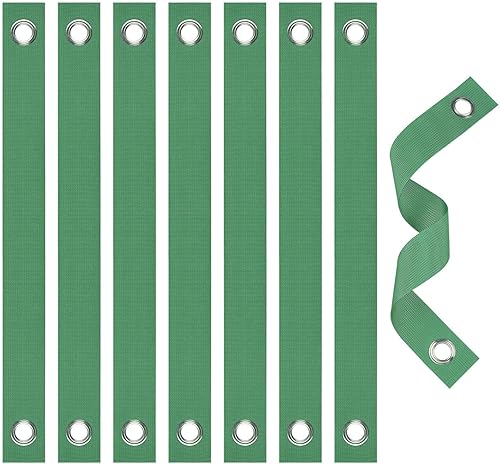
Eps Spiral Tree Stake Kit
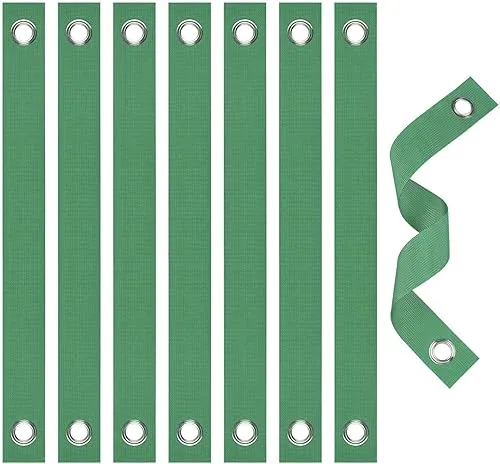
This is a 3-stake kit — three spiral stakes, three ropes, three flat straps with galvanized eyelets, and metal rope adjusters. The three-stake configuration matters: triangulated support is what you want for a tree leaning in one direction or pulling under canopy weight. Two stakes don’t create the same stability.
The straps are the standout feature. They’re wide and flat — genuinely flat, not just slightly wider than rope — and that design is exactly what protects bark from abrasion and girdling damage. The galvanized eyelets on the straps suggest corrosion resistance through wet seasons, which matters if you’re leaving this on through a Pacific Northwest winter.
Installation goes like this: find the point on the trunk where steadying is needed (grab it and feel where support is required — usually lower than people expect), attach the strap, screw the spiral stake into the ground at an angle away from the trunk, run the rope through the stake eyelet, and tighten using the metal rope adjuster. No re-knotting. The metal adjusters make fine-tuning tension quick and repeatable.
The kit ships with protective caps on the stake tips, which is a small detail that signals the manufacturer thought through the product. Stakes are pointy. Caps prevent punctures while you’re rummaging in a box.
The instruction guide includes pictures, which matters more than it sounds when you’re trying to figure out stake angle in the backyard.
What we don’t know: There’s no long-term durability data for this kit. One reviewer tested it in normal garden soil — performance in hard clay, rocky soil, or compacted ground is unknown. Price varies by retailer and isn’t stable enough to quote here; check current pricing on Amazon.
A Note on “Fon” Brand Kits
You may see a nearly identical spiral stake kit listed under the brand name “Fon” — same configuration, same strap design, same illustrated guide. Both products share the same ASIN in the review data, which strongly suggests this is a relabeled version of the same product. If you find it at a lower price, it’s likely the same kit. If the ASINs are genuinely different in the listing, compare the product images carefully before buying.
The One Thing to Avoid
Wire or thin rope looped directly against the trunk. It comes up in almost every tree care discussion for a reason — it’s the most common staking mistake, and it’s usually irreversible by the time you notice it. Even “soft” wire causes damage. If a kit doesn’t include wide straps as a separate component from the rope or wire that anchors to the stake, skip it.
Buying Criteria at a Glance
| Feature | What to Look For |
|---|---|
| Strap material | Wide, flat, non-wire straps |
| Stake type | Spiral (hand-install, no mallet) |
| Hardware | Galvanized eyelets, metal adjusters (not plastic) |
| Kit count | 3-stake kits for triangulated support |
| Extras | Included tension adjusters, pictured instructions |
If You Read Nothing Else
Don’t use wire or thin rope against the bark. Get a kit with wide, flat straps. Spiral stakes are easier to install and easier on the soil than traditional straight stakes. The Eps kit (or its Fon equivalent) covers all the right boxes for a standard young tree staking situation.
Remove the stakes once the tree can stand on its own — usually after one full growing season. Leaving them on too long creates its own problems.