Most Solar Path Lights Are Garbage. These Five Aren't.
This article contains affiliate links. If you buy through them, we earn a small commission at no extra cost to you — it’s how we keep the lights on (pun fully intended).
u/iglidante on r/HomeImprovement said it with 15 upvotes and no ambiguity: “If you want actual output for visibility, hardwired lights on a low voltage circuit is the way to go. It’s a much bigger PITA to set up if you aren’t already wired for landscaping lights, but they actually work as LIGHTS.”
That’s the uncomfortable truth sitting at the center of every solar pathway light thread on Reddit: most of them don’t work well, and many experienced homeowners wish they’d gone wired from the start. Solar path lights are widely bought on the promise of easy, no-wire installation — and most deliver exactly that: easy installation, and then years of disappointment.
That said, a few specific products have earned genuine community praise across multiple independent sources. This guide covers what those are, who they’re actually for, and when you should ditch the solar idea entirely.
The Solar Problem (And Why It Keeps Happening)
The same complaints surface across every thread, year after year:
- Too dim, even brand new
- After 2+ cloudy days, barely visible
- Cheap plastic housings crack within a season
- Batteries degrade and often can’t be replaced
- All-in-one designs (panel integrated into the light body) never charge enough
u/scdayo on r/landscaping put it bluntly with 4 upvotes: “404 Error. Does not exist. Buy some actual LV lights (voltlighting.com for example). Spend a few hours installing them and then enjoy them for a long time.”
And u/iglidante, who has bought roughly 50 solar lights on clearance over five years, reached a clear conclusion: “The housing plastic is garbage on many solar lights. I would not pay full price for ANY of the products on the shelf at HD/Lowes… If you want actual output for visibility, hardwired lights on a low voltage circuit is the way to go.”
So why does this guide exist? Because a few specific solar products genuinely outperform the generic shelf options — and because solar still makes sense for some situations. Here’s an honest breakdown.
Quick Picks
- Best Premium / Brightest Solar — Ring Solar Path Lights · ~$90 starter kit
- Best Overall Solar — Beau Jardin Glass & Metal Lanterns · ~$25–$40/pack
- Best Widely Available — Hampton Bay Parkwood Solar Path Light · ~$10–$15/light
- Best Flush-Mount — Hampton Bay Solar In-Ground Disc · ~$12–$20/light
- Best Value Pack — Tommy Bahama 6-Pack (Costco) · ~$40–$60
- Skip Solar Entirely — Volt Lighting 12V Low-Voltage System
Ring Solar Path Lights {#ring-solar-path-lights}
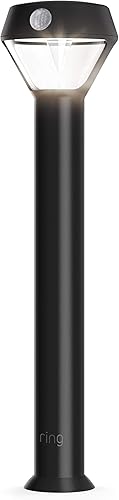
If you want the best solar path light available and price isn’t a dealbreaker, Ring is the answer — and it isn’t particularly close.
In a head-to-head YouTube review testing multiple solar pathway lights, the reviewer found Ring’s lights were “brighter than all other tested lights combined.” They’re motion-activated, integrate with the Ring app, Ring doorbell, and Alexa, and allow control of brightness, motion sensitivity, and network behavior from your phone. During testing, one set functioned after sitting in a dark basement for three weeks with no charging.
On Reddit, u/uhohgowoke67 recommended them over standard solar options: “If you can stretch that budget about $20 more I’d look at the ones Ring makes. They’re bright, hold up well and have motion detection that triggers them all to light up when someone walks by.” And u/whoaretheyy confirmed long-term durability: “I have Ring path lights. Use batteries but mine are still going after 16 months.”
Pros
- Brighter than any other solar path light tested
- Motion activation extends battery life; lights only stay fully bright when needed
- Full smart home integration — Ring app, Alexa, Ring doorbell linking
- Survived 3 weeks without any sunlight charging in testing
- Battery-powered (not true solar), which means consistent brightness regardless of weather
Cons
- Starter kit (2 lights + Ring Bridge) runs ~$90; each additional light is ~$30
- Requires the Ring Bridge to unlock smart features — adds upfront cost
- Overkill if you’re not already in the Ring or Alexa ecosystem
Who this is for: Smart home users who want premium illumination and motion-triggered security lighting. Also for anyone who’s fed up with solar lights that go dim after a cloudy week — Ring’s battery-based system sidesteps that failure mode entirely.
Beau Jardin Glass & Metal Solar Lanterns {#beau-jardin-solar-glass-lanterns}

Every other product on this list uses plastic. Beau Jardin uses glass and metal — and it shows in how they perform over time.
The YouTube reviewer who tested these described them as standing “about a foot tall” with construction that’s “durable and weather resistant, surviving impact tests and a harsh New England winter.” They hold a charge even on cloudy days and reportedly shine days later when brought in from outdoor storage — an unusual claim for solar lights, but consistent with the more substantial build.
The warm white glow is subtle enough to blend into landscaping without looking like you stapled plastic toys to your lawn, which is more than most solar path lights can say.
Pros
- Glass and metal construction — outlasts plastic by years in outdoor conditions
- Survived New England winter testing without failure
- Works on cloudy days and holds charge in indoor storage
- Warm white glow, not the cold blue common in cheaper solar lights
Cons
- Glass means more fragile than plastic if physically struck
- Still performs best in direct, full-day sun — cloudy climates reduce effectiveness
- Reddit community awareness is lower than Hampton Bay or Ring; fewer long-term reviews
Who this is for: Buyers who want a solar option that doesn’t look or feel cheap, and who prioritize build durability over app features. Also good for areas where consistent sun exposure makes solar viable.
Hampton Bay Parkwood 14-Lumen LED Solar Path Light {#hampton-bay-parkwood-14-lumen}
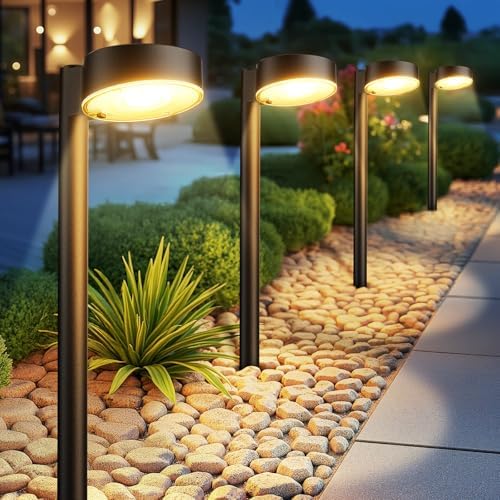
Hampton Bay shows up consistently across both Reddit and YouTube as the most recommended solar path light available at a big-box store. The Parkwood is their flagship stake model: filament-style LED, dusk-to-dawn automatic operation, no tools required, sold in single or 4-pack configurations at Home Depot.
The filament LED design matters more than it sounds. u/dkanaya007 in Canada noticed: “I have recently been impressed with a few solar LED stakes that have a long, filament-type of LED/bulb casing. They seem to give off a lot more light than the ones with a tiny nub of an LED. Both brands shine bright, and continue to all work a year later after being left out all winter.” Hampton Bay was one of the two brands they specifically named.
The YouTube review covering Hampton Bay’s lineup noted these are “among the highest rated solar products at Home Depot” with reliable automated operation and solid construction for the price.
Pros
- Widely available at Home Depot — easy returns, easy replacements
- Filament-style LED noticeably brighter than competing designs with small nub LEDs
- True dusk-to-dawn automation, no manual switching
- One of the most consistently recommended solar path lights across multiple communities
Cons
- 14 lumens is still modest — decorative marker lighting, not functional illumination
- 1-year warranty is limited for an outdoor fixture
- Noticeably dims after 2+ consecutive cloudy days
Who this is for: Homeowners who want a low-hassle solar path marker from a brand they can return locally if it fails. Good for sunny climates; less ideal for the Pacific Northwest or anywhere with persistent overcast stretches.
Hampton Bay Solar In-Ground Disc Path Light {#hampton-bay-solar-disc}

Same Hampton Bay reliability, different form factor. These flush-mount pucks sit level with the ground — mowers pass right over them, they’re nearly invisible in daylight, and they create a clean, minimalist edge along walkways or pool surrounds.
The YouTube reviewer described them as weatherproof, rust-resistant, and praised for “brightness and overall performance” relative to other puck-style solar lights. Installation is flexible: either screw them down or use the included plastic spikes (though the spikes need careful handling).
Pros
- Flush-mount design survives lawn mowers and foot traffic
- Weatherproof and rust-resistant
- Clean, low-profile aesthetic — doesn’t dominate the landscape
- 15-lumen output is respectable for the disc form factor
Cons
- Plastic surrounding the aluminum frame can develop cracks over time
- Included spike option is fragile during installation
Who this is for: Gardeners who want pathway definition without visible stakes — especially useful along pool decking, stepping stones, or anywhere a traditional stake would look awkward.
Tommy Bahama Solar Pathway Lights, 6-Pack (Costco) {#tommy-bahama-costco}
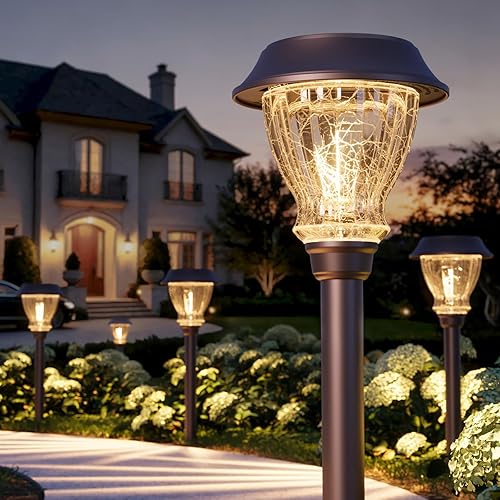
The Tommy Bahama 6-pack at Costco has a small but vocal fanbase — two separate Reddit users mentioned it approvingly in threads specifically about solar lights that don’t disappoint. u/Honest-Sugar-1492 gave it exactly the kind of endorsement that carries weight: “I have Tommy Bahamas from Costco. Love em.” Short, unprompted, in a thread full of complaints.
At 30 lumens per light, these are brighter than many competitors in the decorative range. Costco’s return policy provides meaningful protection that big-box garden section doesn’t always match.
Pros
- Mentioned approvingly by multiple independent Reddit users
- 30-lumen output is solid for decorative pathway marking
- Costco’s return policy covers disappointment
Cons
- Limited seasonal availability — not always in stock
- 30 lumens is still on the lower end for functional nighttime visibility
- No ASIN-based availability guarantee; check Costco.com directly
Who this is for: Costco members who want a decent mid-range decorative path light without committing to smart home pricing or specialty brands. Buy it when it’s in stock.
The Wired Alternative: When You Should Just Skip Solar {#the-wired-alternative}
Multiple experienced homeowners on Reddit reached the same conclusion independently: after cycling through multiple sets of solar lights, they switched to low-voltage wired systems and wished they’d done it sooner.
u/YosemiteDaisy summed up the transition: “We also did solar lights but after buying multiple sets over the years — we went with wires and honestly… wired has a nicer quality of light and it was worth while for us.”
The economics are closer than people expect. u/thepianoman2 installed 8 wired lights, 100 ft of wire, and a 200W transformer for $180 — that’s $22.50 per light, comparable to mid-range solar per-unit pricing with none of the cloud-dependent performance issues.
Volt Lighting (voltlighting.com) is the brand that comes up most often in serious landscape lighting discussions. u/empyreanhaze on r/HomeImprovement recommended them with 102 upvotes: “voltlighting.com sells really high quality metal stuff, decent prices. They do mostly 12v wired stuff, but some 120v and solar is available too.”
Go wired if any of these apply:
- You get regular snow (panels get buried; lights fail)
- Your installation area is partially shaded
- You want actual functional illumination, not just decorative markers
- You’ve already bought and replaced at least one set of solar lights
- You’re tired of dimming after two cloudy days
Low-voltage 12V installation doesn’t require an electrician. The wire doesn’t even need to be buried — it can tuck under mulch in garden beds. The one-time effort pays off in years of reliable, consistent lighting.
A Few Things Worth Knowing Before You Buy Any Solar Light
Replace the plastic stakes with wooden dowels. u/Seven_bushes (24 upvotes) figured this out: “I got dowel rods of the correct diameter, cut them to length, hammered them far into the ground, and slid the lights over them. The lights stay straight now but also aren’t too rigid that they would hurt my dog in an accidental zoomies crash.”
Battery replacement matters more than you think. Lithium solar batteries degrade in roughly 2 years. If your lights don’t allow battery replacement, you’re buying disposables. Upgrade factory batteries with quality rechargeable NiMH — they’ll meaningfully improve both brightness and run time. Never use alkaline batteries in solar lights — fire risk.
Separate solar panels outperform all-in-one designs. When the panel and light are integrated into one housing, the panel rarely faces optimal sun. Designs where the panel sits on a separate stake — positioned independently for max exposure — consistently outperform.
Only buy cheap solar lights on deep clearance. If you’re buying generic big-box solar lights, 50% off or more is the right price. At full retail, the value proposition doesn’t hold.
Dollar Tree and Big Lots solar lights are not worth your time. Multiple users, multiple threads, unanimous verdict.
The Bottom Line
If you’re in a sunny climate, want zero installation effort, and understand these are path markers rather than functional lights: Hampton Bay Parkwood is your cleanest widely-available option. Tommy Bahama at Costco if you catch it in stock.
If you want something that actually looks good for years: Beau Jardin glass lanterns are built to last in a way plastic-housing competitors aren’t.
If you want the best solar path lights available, period, and you’re already in the Ring ecosystem: Ring Solar Path Lights are not even close to the competition in brightness and features.
If you’ve ever been frustrated by solar lights dimming after cloudy days, or you live somewhere with real winters: wire it. One afternoon of installation, years of reliable light. Volt Lighting is where to start.