Most 'Self-Watering Planters' Aren't Built for Vegetables. Here's What Is.
This article contains affiliate links — if you buy through them, we may earn a small commission at no extra cost to you.
Search “best self-watering planter for vegetables” and you’ll get a wall of results for cute little terracotta-style pots sized for a pothos or a succulent. They’re marketed broadly as “self-watering,” they look great on a windowsill, and they will absolutely not sustain a tomato plant.
The dirty secret of this category: most self-watering planters aren’t designed for vegetables at all. They’re decorative container pots with a small reservoir underneath. Vegetables — tomatoes, peppers, zucchini, cucumbers — need 5 to 15+ gallons of root space per plant and consistent moisture at scale. A 6-inch pot with a half-cup reservoir isn’t going to cut it.
Fair warning: source data for this category is thin. We found one YouTube review directly relevant to outdoor vegetable growing, and one covering smaller decorative self-watering pots. No Reddit community data was available. Treat these findings as directional, not definitive — but the core buying principles are sound regardless of which specific products you end up with.
Answer This First: What Are You Actually Growing?
Before you look at any product, answer two questions:
Are you growing outdoors or indoors? Outdoor vegetable growing demands large soil volume, weather-resistant materials, and UV-stable construction. Indoor herb growing (basil, mint, parsley) is a totally different problem.
What’s your target plant? Herbs and small greens can work in a 6–12 inch pot. Tomatoes, peppers, squash, and most fruiting vegetables need 10–20+ gallons of container volume, full stop. If a product listing doesn’t mention soil capacity in gallons or cubic feet, that’s a red flag.
Once you know where you fall, the choice becomes much clearer.
For Outdoor Vegetable Growers: Cedar Craft Elevator Planter

~$150–$250 · Buy on Amazon
If you’re growing vegetables on a patio, deck, or balcony and want a self-watering setup that’s actually sized for the job, the Cedar Craft Elevator Planter is the most credible option we found. It holds roughly 4.5 cubic feet of soil (two to two-and-a-half standard bags), and the sub-irrigation reservoir holds three to four gallons — enough to meaningfully extend the time between waterings during a hot week.
The design is elevated to raised-bed height, which is nice for your back and keeps ground-level pests out. Cedar sides, aluminum L-brackets, and stainless steel screws mean it’s built for outdoor conditions. The reservoir has a fill spout with a bobber float indicator so you can tell at a glance whether it needs topping up — that kind of visible water level check matters more than it sounds when you’re doing daily garden rounds.
What the review actually said: “Build quality is fair to good — not perfect but totally fine.” That’s an honest summary. Some cedar pieces arrived damaged or misaligned, screw hole alignment was inconsistent in spots, and the paint on metal components scratched during assembly. None of these are dealbreakers, but this isn’t a premium precision product — it’s a functional outdoor planter with some rough edges.
One important DIY add-on: line the interior with plastic sheeting before filling with soil. Cedar will degrade in contact with moist soil over time, and a cheap plastic liner can add years to the planter’s life. It’s not included in the kit, but it’s a 10-minute job with a staple gun.
Skip the casters. The included casters let you roll the planter around, but on a deck with any wind, a caster-mounted planter loaded with wet soil becomes a liability. Most reviewers leave them off.
Best for: Deck or patio vegetable growers who want an elevated self-watering raised bed with enough root room to grow real food — tomatoes, peppers, beans, squash.
For Indoor Herbs and Container Plants: Raindrop Indicator Pot
~$28–$35 · Buy on Amazon
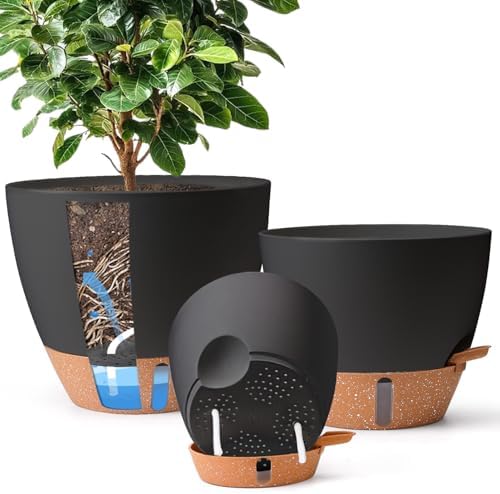
If your goal is a reliable indoor self-watering pot for herbs or houseplants, the Raindrop Indicator pot earned a notably clean review. The design skips the cotton wicking cord that plagues cheaper options — instead, pockets and channels let the growing medium draw water directly. That matters because cotton wicks rot in standing water, smell bad after a few months, and eventually stop working. Synthetic or stringless designs outlast them consistently.
The raindrop-shaped water level window is genuinely useful — clear, easy to read, no tilting or lifting required. Reviewer’s verdict: 8 out of 10, docked only for price. “Everything else has been perfectly hunky-dory — the only thing bringing it down is the price.”
At $30+ for a single pot, it’s not cheap. But if you want a low-maintenance herb pot that won’t develop a smell problem in six months, the design logic is right.
Not for vegetables. This is a houseplant-scale container. Great for basil, mint, or small peppers on a windowsill. Not for anything that needs serious root volume.
Budget Option: Small Self-Watering Pack of 8

~$15–$25 for 8 pots · Buy on Amazon
(Note: currently unavailable on Amazon; may be findable through secondary sources.)
A pack of eight small self-watering pots at roughly $2–3 each is the obvious entry point if you’re starting out or want to try the format without committing. The pots have a relatively clear reservoir and the holes are small enough to prevent fine growing medium from falling through — both good signs.
The problem is the cotton wick. It works at first, then rots in standing water, introduces smell, and eventually fails. One reviewer put it plainly: “The rotting cord takes away three points — it smells horrid.” The fix is replacing cotton strings with strips of microfiber cloth, which wicks just as well and doesn’t decompose. It’s a minor mod, but it’s worth knowing before you buy.
These are for herbs and small plants only — the capacity is nowhere near what vegetables need.
Best for: Budget herb growers willing to do a quick wick swap. Not for outdoor vegetable production.
What to Avoid
A few patterns that consistently cause problems in this category:
Cotton wicking cords. They rot. The smell is real. Replace with synthetic microfiber if you’re stuck with a cord-based design, or buy stringless from the start.
No drain/flush access. If you can’t drain or flush the reservoir without disassembling the whole planter, you can’t manage mineral buildup or correct overwatering. One reviewed design with this flaw scored 2 out of 10. Check before buying.
Undersized containers marketed for vegetables. A 6-inch pot with a decorative “self-watering” reservoir is not a vegetable planter. Check the listed soil volume in gallons — anything under 5 gallons is herbs-only territory.
No water level indicator. Without a float, bobber, or clear window, you’re lifting and tilting the planter every time you need to check the reservoir. It’s a small thing that quickly becomes annoying.
The Short Version
| Use Case | Pick |
|---|---|
| Deck/patio vegetables | Cedar Craft Elevator Planter |
| Indoor herbs, low maintenance | Raindrop Indicator Pot |
| Budget herbs, okay with minor DIY | Small Self-Watering Pack of 8 |
If you’re here to grow actual food outdoors, the Cedar Craft is the only option in this roundup sized for the job. For everything else — herbs, small greens, indoor plants — any of the smaller pots will work, but prioritize visible water indicators and avoid cotton wicks.