Raised Bed Soil: Answer These 3 Questions Before You Buy a Single Bag
This guide contains affiliate links. If you buy something through them, we earn a small commission at no extra cost to you — it’s how we keep the research going.
The most upvoted comment in a 233-point r/gardening thread about raised bed soil reads like this: “All soil is going to shrink and settle. You just top it off every year with fresh compost.” — u/drawerdrawer, 593 upvotes.
That’s it. That’s the secret. Everything else is details.
But the details matter when you’re staring at a $400 soil bill for a couple of 4x8 beds, or when you’ve hauled home twelve bags of “topsoil” that turned out to be dense gray clay with rocks in it. So here’s a framework that cuts through the YouTube rabbit holes and gives you an honest answer based on what actual gardeners are doing.
Answer These 3 Questions First
1. How much soil do you actually need?
Before touching anything else: calculate your bed volume (length × width × depth in feet = cubic feet). Then do the math on bags vs. bulk.
A 2 cu ft bag of bagged soil runs $8–$18. That same volume from a local landscape supply yard costs roughly $1–$2 as part of a bulk order (~$25/cubic yard, which is 27 cubic feet). For two 4×8×12” beds you need about 64 cubic feet of soil. At bag prices: $256–$576. At bulk prices: $60–$70 delivered to your driveway.
u/AtxTCV on r/vegetablegardening put it plainly: “Find a local bulk soil or landscape supply yard. They will have garden soils for your local areas premixed and ready for pickup/delivery far cheaper than bagged stuff from Home Depot.”
If you need more than ~20 cubic feet: price out bulk first. Bags are for small fills and annual top-dressing.
2. Are you filling a new bed or maintaining an existing one?
- New bed, large volume → Bulk landscape mix + compost blend, or DIY Mel’s Mix
- New bed, small volume → Bagged raised bed soil (Kellogg, FoxFarm, E.B. Stone)
- Existing bed, annual top-off → 2–3 inches of compost. Period. Don’t overthink this.
- Existing bed with known deficiencies → Get a county extension soil test first. Seriously.
u/Ceepeenc on r/vegetablegardening ran a test and found excessive phosphorus and calcium in beds they’d been amending for years: “I don’t have to amend with anything. Don’t spend money unnecessarily. Test it to know for sure what is needed.” Over-amending is a real and common problem.
3. Where do you live?
This matters more than most guides admit. Some of the best-reviewed products are West Coast only (Kellogg, E.B. Stone Bumper Crop). The Northeast has Coast of Maine. Miracle-Gro and FoxFarm ship nationally. If you’re in a major metro, your local landscape yard probably has a climate-appropriate blended mix that’s better than anything shipped across the country.
The DIY Route: Mel’s Mix
Before covering bagged products, it’s worth naming what Reddit consistently calls the best-performing option at any scale: Mel’s Mix.
The recipe (from u/galileosmiddlefinger, 12 upvotes, r/vegetablegardening):
- 1/3 peat moss or coco coir
- 1/3 coarse vermiculite or perlite
- 1/3 blended compost (ideally 2–5 different types)
u/HelpfulJones describes filling their first two beds with a version of this using Black-Kow and a chicken-litter compost: “That first year grew amazingly well and everything I planted produced gobs of veggies… admittedly, those beds will grow the most expensive veggies that will ever cross my lips.”
The catch: Mel’s Mix is expensive to assemble from bags. It makes financial sense if you’re sourcing bulk vermiculite and compost locally, or if you’re filling a small bed where soil quality matters more than cost.
The Bagged Products: Ranked for Your Situation
If you’ve determined bagged soil is the right call, here’s what to buy.
Kellogg Garden Organics Raised Bed Mix — Best West Coast Pick

If you’re in California, Oregon, or Washington and shopping at Home Depot or Lowe’s, this is the move. The formula (aged chicken manure + composted bark + pumice) hits the trifecta: drainage, nutrients, and beneficial biology. The inclusion of mycorrhizal fungi gives transplants a head start.
u/HeeeyShaneFalco on r/gardening (29 upvotes) recommends it specifically for small bed fills: “I’d recommend Kellogg’s Organics Raised Bed and Potting Mix if available. Grab some composted steer manure to mix into the top few inches of soil.”
Pros
- Widely available at big-box stores on the West Coast
- Chicken manure + pumice combo praised for drainage and nutrients
- Affordable for a premium organic product
- Includes beneficial microorganisms and mycorrhizal fungi
Cons
- Regional — primarily West Coast; not reliably found in the Midwest or East
- Will settle like any bagged soil; annual topping required
Best for: West Coast gardeners who want a ready-to-use organic mix without DIY mixing.
FoxFarm Ocean Forest — Best for Heavy Feeders Nationally

Ocean Forest has a legitimate cult following because it earns it for specific applications. The marine-based ingredients — crab meal, fish meal — add micronutrients that generic inland mixes simply don’t have. The YouTube gardening roundup puts it well: “Ocean Forest has developed a cult following among serious gardeners who demand premium quality for their prized plants.”
Technically it’s a potting mix, not a raised bed soil, which means it can be nutrient-rich to the point of overwhelming sensitive plants like herbs or greens. Use it for tomatoes, peppers, and other heavy feeders. For mixed beds, blend it 50/50 with a cheaper raised bed soil.
Pros
- Marine-based ingredients (crab meal, fish meal) add micronutrients
- Strong community reputation among experienced growers
- Reduces need for additional fertilizers for heavy feeders
- Nationally available
Cons
- Higher price ($25–$35 per 2 cu ft bag)
- Can be too rich for light feeders — dilute for mixed plantings
Best for: Serious vegetable gardeners growing tomatoes and peppers who want premium nutrition from day one.
E.B. Stone Bumper Crop Raised Bed Soil — Best Premium West Coast Pick
This one flies under the radar because it’s only at independent Master Nursery Garden Centers, not big-box stores — but the gardening YouTuber who tested it for months had an unusually visceral reaction: “I’ve used so many poor soils in my life that’s filled with lots of fillers like wood chips that just rob the nitrogen from the soil. And look at the amazing quality of the soil. It’s black and rich. No heavy fillers.”
The coco coir base (not peat) is the key differentiator: it moistens immediately without pre-wetting, retains water better in dry climates, and has a smaller ecological footprint. Pumice for aeration, worm castings and chicken manure for nutrients — no added fertilizer needed at planting. Regionally manufactured, so prices stay reasonable despite premium ingredients.
Pros
- Coco coir base outperforms peat for water retention and ease of wetting
- Contains worm castings, chicken manure, and pumice — complete at planting
- Fine fir bark for slow nutrient release without nitrogen robbing
- Better value than FoxFarm for comparable quality
Cons
- Only at independent Master Nursery Garden Centers — not big-box
- West Coast production; not available in most of the country
Best for: West Coast gardeners near an independent garden center who want a premium all-in-one mix.
Coast of Maine Stonington Blend — Best Northeast Pick
The East Coast answer to E.B. Stone. What makes it genuinely interesting is the composted lobster shells — a byproduct of the Maine seafood industry — which add trace minerals that inland products don’t carry. It performs consistently in both drought and waterlogged conditions, which matters in New England. If you’re in the Northeast and have an independent garden center nearby, this is worth finding over Miracle-Gro.
Pros
- Lobster shell compost adds trace minerals absent from inland mixes
- Sustainably sourced from seafood processing waste
- Consistent performance in variable weather conditions
Cons
- Primarily Northeast regional availability
- Higher price point ($18–$28 per 2 cu ft bag)
Best for: Northeast gardeners who want regional sourcing and marine-derived micronutrients.
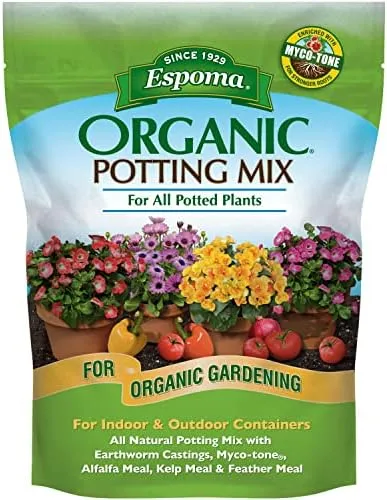
Espoma Organic Potting Mix — Best for Certified Organic Growers
The differentiator here is MycoTone — Espoma’s proprietary beneficial fungi blend — and OMRI-listed organic certification. Multiple gardeners report reduced transplant shock and better establishment. The soil improves with age as organic components continue breaking down, making it a better long-term investment than synthetic-amended mixes.
Pros
- MycoTone beneficial fungi blend reduces transplant shock
- OMRI-listed certified organic
- Soil improves over multiple seasons
Cons
- Not always stocked at big-box stores; may require nursery or online order
Best for: Organic-focused gardeners who need certified inputs and want soil biology to build over time.
Miracle-Gro Raised Bed Soil — The Reliable Baseline
Reddit treats Miracle-Gro as the floor, not the ceiling. It’s everywhere, it works, it feeds plants for 3 months without supplementation, and it won’t surprise you. u/Aslanic on r/gardening (12 upvotes) sums up the Miracle-Gro user profile accurately: “I typically go for big brand names like Miracle Grow just for ease of access and pricing.”
The peat moss base can be hydrophobic when dry (pre-moisten before planting), and organic growers will want to skip it due to synthetic fertilizer content. But for a first-year beginner who needs results without troubleshooting, it delivers.
Pros
- Nationally available everywhere
- Slow-release fertilizer included, feeds up to 3 months
- Consistent, reliable results
Cons
- Peat-based — hydrophobic when dry; pre-wet before planting
- Synthetic fertilizer content is a drawback for organic growers
- Not the most nutritionally complex option
Best for: Beginning gardeners who want reliable, widely available results without amendments.
Quick Comparison
| Product | Price/2 cu ft | Base | Organic | Availability | Best Use |
|---|---|---|---|---|---|
| Kellogg Raised Bed Mix | $8–$15 | Bark + manure | Yes (OMRI) | West Coast big-box | General veggies |
| FoxFarm Ocean Forest | $25–$35 | Peat + marine | Yes | National | Tomatoes, peppers |
| E.B. Stone Bumper Crop | $12–$18 | Coco coir | Yes | West Coast indie | Premium all-in-one |
| Coast of Maine Stonington | $18–$28 | Bark + lobster | Yes | Northeast indie | Regional premium |
| Espoma Organic | $12–$20 | Peat | Yes (OMRI) | Nurseries/online | Organic certification |
| Miracle-Gro Raised Bed | $10–$18 | Peat | No | National big-box | Beginners |
The One Thing That Overrides All of the Above
Annual compost top-dressing. u/drawerdrawer’s 593-upvote answer is correct: every soil settles, and the fix is 2–3 inches of fresh compost each spring. If you source bulk compost from a local landscape yard (~$25/cubic yard), this costs almost nothing and keeps beds productive indefinitely.
Before adding amendments to an established bed, get a county extension soil test. It costs $15–$25 and prevents the common trap of over-loading phosphorus and calcium from years of well-intentioned compost additions — a problem multiple experienced r/vegetablegardening users have walked into.
The short version: Price out bulk for large fills. Use Mel’s Mix or a premium regional bag for small beds. Top-dress with compost every year. Test before you amend. Everything else is optimization.