Skip the Weather Station. Just Buy the Stratus.
Heads up: links in this article are affiliate links. If you buy through them, we earn a small commission at no extra cost to you.
Most gardeners researching rain gauges end up in the same rabbit hole: weather station reviews, tipping-bucket explainers, and app-connected gadgets that cost $150+. Then they realize they just wanted to know if they need to water the tomatoes tomorrow.
Here’s the short version: buy the Stratus if you want accuracy that lasts a decade, or the AcuRite 00850 if you want to spend $12 and call it done. Everything else is either overkill or a downgrade.
The Winner: Stratus Precision Rain Gauge

$30–$45 · Buy on Amazon
The Stratus is the gauge that National Weather Service volunteer observers actually use. That’s not marketing copy — it’s a meaningful signal. When people who care about measurement accuracy for scientific purposes reach for the same $40 tool you’re considering for your backyard, that’s worth something.
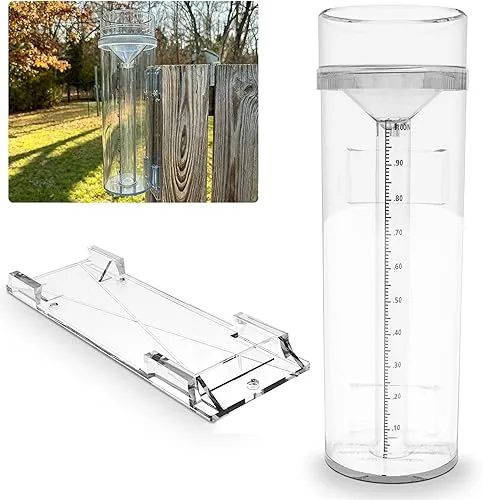
What makes it genuinely different from a standard tube gauge is the two-chamber design. The inner tube measures the first inch of rainfall to the nearest 1/100th of an inch. The outer chamber handles overflow up to 11 inches — so if you forget to empty it before a heavy storm, you won’t lose the reading. That’s a real-world feature that tube gauges can’t match.
u/DeltaGentleman on r/myweatherstation explained it plainly: “I’m using my second Stratus. My first one lasted 8 years or so.” That’s two purchases over what might be 15+ years of reliable use for a $40 tool. The value math is obvious.
u/jaybrown0 gave the most concise endorsement in the thread: “Simple and accurate.” That’s the whole pitch.
Pros
- Measures first inch to 1/100th precision — far better than most tube gauges
- 11-inch overflow capacity means no missed readings after heavy rain
- No batteries, no app, no connectivity failures — ever
- Mounting bracket included for fence or post installation
- Trusted by NWS volunteer observers
Cons
- Requires manual emptying — no self-emptying mechanism
- Slight learning curve to read the two-chamber system correctly
- No wireless or remote monitoring capability
Who it’s for: Anyone who wants a rain gauge they can install once and trust completely for years. Especially valuable in regions with frequent heavy rain where tube gauge accuracy degrades.
The Budget Pick: AcuRite 00850 A2
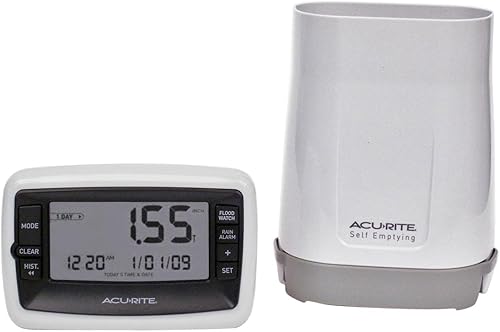
$10–$20 · Buy on Amazon
If the Stratus is overkill for your needs, the AcuRite 00850 is genuinely good for what it is. It’s a five-inch capacity tube gauge with 35% magnification built into the tube wall — meaning you can read it from several feet away without leaning in. No setup, no batteries, no configuration.
u/tiffownsthis on r/lawncare put it best: “I use this cheap and simple gauge and I love it. Check and empty after every rain storm.” That last sentence is the key caveat. This gauge requires a consistent habit. Skip emptying it after one storm, and the next reading is corrupted.
The accuracy trade-off is real and worth understanding. A YouTube reviewer covering the AcuRite noted directly: “While measuring smaller rainfalls without trouble, heavier rainfall might have a significant error. If you reside in an area prone to rainfall, these errors build up as time goes by.” If you’re in Seattle or coastal Florida, that’s a meaningful limitation. If you’re in a moderate-rainfall region and mostly want to know “did we get enough rain to skip watering today,” it’s fine.
Pros
- Under $20, widely available
- 35% magnification for distance reading
- 5-inch capacity covers most single-storm events
- Zero setup, zero ongoing costs
Cons
- Accuracy degrades in heavy or frequent rainfall
- Manual emptying required — no exceptions
- Not well-suited to high-rainfall climates
Who it’s for: Gardeners in moderate-rainfall areas who want a quick sanity check on irrigation needs without spending more than lunch money.
Head-to-Head
| Stratus Precision | AcuRite 00850 | |
|---|---|---|
| Price | $30–$45 | $10–$20 |
| Capacity | 1” inner / 11” outer | 5” |
| Precision | 1/100” on first inch | ~1/4” typical |
| Heavy rain accuracy | Excellent | Degrades |
| Batteries required | No | No |
| Setup time | 5–10 min (mounting) | 30 seconds |
| Expected lifespan | 8–10+ years | 3–5 years |
| NWS-grade accuracy | Yes | No |
The price gap is real but so is the performance gap. The Stratus costs roughly 2–3x more and delivers meaningfully better accuracy — especially when it matters most, during heavy storms. Over a decade of use, the Stratus is also the cheaper option per year.
What to Skip
Full weather stations if you only need rainfall data. The $150–$700 weather station market is full of capable products, but their rain gauge components are typically tipping-bucket designs that aren’t more accurate than the Stratus and introduce failure modes (battery death, connectivity drops, console resets) that analog gauges never have. One reviewer on r/weather noted the Ambient WS-2902’s annual rain counter “can’t be reset remotely — you have to hold buttons down on the LCD console.” That’s the kind of friction that accumulates.
Tipping-bucket wireless gauges in general. Multiple sources flag this: tipping-bucket mechanisms have known accuracy tradeoffs at high rainfall rates. One commenter reviewing a LaCrosse-style gauge noted they “clearly have a finite life.” The mechanism that makes them convenient (self-emptying) is also the mechanism that makes them less accurate in the conditions where accuracy matters most.
Digital gauges claiming “last 24 hours” totals. A documented complaint across multiple products: gauges that advertise 24-hour totals actually reset at midnight, not 24 hours from the last reading. One YouTube reviewer flagged this explicitly: “It states that it shows last 24 hours… this is incorrect for the 24-hour reading. It is actually from midnight to midnight.” Verify behavior before buying if historical logging matters to you.
Unknown-brand cheap digitals. The pattern in community feedback is consistent: they work briefly, then stop. You’ll spend more replacing them than the Stratus costs once.
Placement Matters as Much as the Gauge
A few practical notes that Reddit consistently surfaces:
- Avoid roof drip lines. Even a small overhang will concentrate rainfall at the gauge and skew readings high.
- Keep it clear of overhead obstructions. Tree canopy, pergolas, and eaves all intercept rain before it reaches the gauge.
- Pick a consistent spot. If you move the gauge between readings, you’re measuring location variance as much as rainfall.
- Cold climates: If you’re shopping in a cold-weather region, verify freeze resistance explicitly. Some analog gauges (the Headwine is specifically called out in reviews) are not freeze-rated. The Stratus handles all-weather conditions as its name suggests.
The Bottom Line
Buy the Stratus. It’s the gauge that hobbyist weather observers, NWS volunteers, and Reddit’s gardening and weather communities consistently recommend when someone asks for accuracy without complexity. The two-chamber design, the 1/100” precision on the first inch, the 11-inch overflow capacity, the decade-plus lifespan — it’s a well-engineered tool that costs less than a dinner out and solves the problem completely.
If you genuinely can’t justify $35 and you’re in a moderate-rainfall area, the AcuRite 00850 is an honest budget option. It does what it says. Just be disciplined about emptying it.
Everything else — weather stations, tipping-bucket wireless gauges, app-connected setups — is solving a different problem than “I need to know how much rain my garden got.” If that’s your question, the Stratus has your answer.