Before You Buy a Rain Barrel, Answer These 4 Questions
This article contains affiliate links — if you buy through them, we earn a small commission at no extra cost to you.
A comment on r/HomeImprovement with 81 upvotes says everything you need to know about buying a rain barrel: “One thing he quickly learned was how little rain it takes to fill his barrel. Make sure to have an overflow system in place.”
That’s the core problem with most rain barrel buying guides. They compare brands and aesthetics when the real question is whether 55 gallons is even enough for what you’re trying to do. Spoiler: for most serious garden use, it isn’t. Experienced collectors say the same thing on every thread — they started too small, and now they’re expanding.
But “get a bigger barrel” isn’t universal advice either. The right setup depends on four things: how much water you need, how comfortable you are with basic plumbing, how much space you have, and what your roof looks like. Work through these questions first, then scroll to the recommendation that fits.
One critical note before anything else: rainwater harvesting is regulated at the state and local level. Some jurisdictions prohibit it entirely; others cap volume or restrict usage. Check your local ordinances before spending a dime.
Question 1: How Much Water Do You Actually Need?
This is where most buyers go wrong. A 50-55 gallon barrel sounds substantial until you realize a heavy rain can fill it in 20 minutes from a standard downspout.
As u/TheApostleCreed put it on r/homestead: “You’d be surprised by how fast 55 gallons gets filled up though.”
If you have a small garden (under 200 sq ft) or you’re just getting started, a single 50-55 gallon purpose-built barrel is probably fine. You’ll run dry in a long drought, but for supplemental watering it’s workable.
If you have a medium-to-large garden, or you want meaningful drought resilience, you need either multiple linked barrels or an IBC tote. There’s no way around this. One r/preppers user described their approach: “I have at least 750 gals of rain water catchment capacity and am expanding it every few years.” That’s not a prepper extreme — that’s what it takes to actually run a garden off rainwater.
Question 2: Are You Comfortable With Basic DIY Plumbing?
This is the fork in the road.
If you want plug-and-play: Buy a purpose-built decorative barrel. They cost $80-$150, include a spigot and overflow, and require minimal setup — connect the downspout diverter, position the barrel, done.
If you’re willing to spend a few hours for significant savings: Food-grade used barrels and IBC totes are dramatically cheaper per gallon and offer far more capacity. The trade-off is that you’ll need to source a diverter, drill and fit a spigot, and think through your overflow setup.
Question 3: Does Aesthetics Matter For Your Setup?
If the barrel is visible from your main yard or a neighbor’s sightline, appearance may matter. If it’s behind a garage or in a side yard, it probably doesn’t.
Appearance matters → go purpose-built. The decorative options are decent-looking. The DIY options — food drums and IBC totes — are utilitarian to the point of being ugly.
Appearance doesn’t matter → go DIY. You’ll get 5x the water storage for the same money.
Question 4: How Many Trees Are Above Your Roof?
This one determines which diverter to buy, not which barrel. But it matters a lot.
Light leaf coverage → the standard EarthMinded kit works fine. Heavy tree coverage → you need a diverter with clog bypass, or you’ll be dealing with storm overflow events. More on this in the accessories section below.
The Recommendations
If You Want Easy and Polished: RTS Home Accents 55-Gallon Premium Rain Barrel
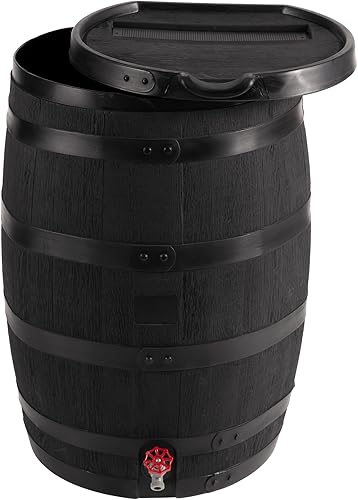
This is the best of the purpose-built options. The removable lid makes it easy to clean (something competitors skip), the brass spigot gets consistently praised as leak-free, and the flat-back design tucks neatly against a fence or wall. At 55 gallons it’s the largest you’ll find in this category without going DIY.
Pros
- Removable lid — actually maintainable over time
- Brass spigot, not plastic — holds up longer
- Flat-back design saves space
- Built-in overflow that redirects away from your foundation
- UV-resistant polyethylene rated for multi-year outdoor use
Cons
- 55 gallons fills fast — serious gardeners will outgrow this quickly
- Real-world owner reviews are sparse; most coverage is affiliate YouTube content
Who it’s for: Homeowners who want a clean, finished-looking barrel with zero assembly beyond connecting the downspout. The removable lid alone justifies the price premium over similar barrels.
Price: $100–$150
If Aesthetics Are a Priority: Good Ideas Rain Wizard 50-Gallon

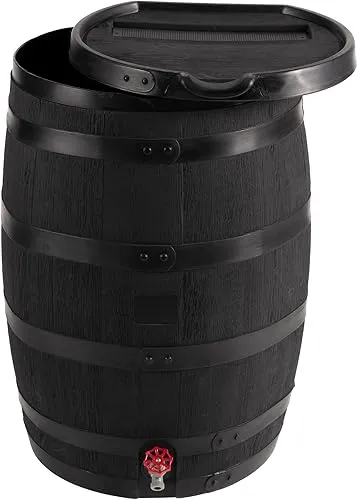
The faux wood grain with black stripe design actually looks decent in a landscaped yard. It includes a mesh debris screen and a metal spigot. Functionally it’s similar to the RTS barrel — 50 gallons, flat-back, overflow included — but it’s optimized for situations where the barrel will be seen.
Pros
- Most attractive purpose-built option available
- Mesh screen filters debris at the inlet
- Metal spigot is more durable than plastic alternatives
- Flat-back design
Cons
- You pay a premium for aesthetics over the more functional RTS barrel
- 50-gallon capacity is on the low end
Who it’s for: Front-yard or visible placements where the barrel will be part of your landscaping composition, not hidden behind it.
Price: $90–$130
If You Want to Save Money and Scale: Food-Grade 55-Gallon DIY Barrel
This is what experienced collectors almost universally recommend once they’ve done it once. Used food-grade barrels — pickle drums, olive barrels, car wash drums — are available on Craigslist and Facebook Marketplace for a fraction of what purpose-built barrels cost. From r/preppers, u/therealharambe420 (5 upvotes) lays out the approach cleanly: “Buy used food grade barrels from FB or CL. I get used pickle barrels locally 2/$25. Buy a bulk head fitting a gate valve or boiler valve for a hose attachment.”
From the same thread, u/zeddwood describes how to chain them together: “44 Gallon Brute Food grade trash cans, about 50 bucks at Lowes with a lid. Just buy a couple of 90s and run your downspout through a hole in a lid. I cut a small hole at the top of the first can and run a washing machine discharge hose to the next can.”
That’s the key advantage here: daisy-chaining. Add a second barrel when you need more capacity. And a third. The washing-machine-discharge-hose method is cheap and reliable.
Pros
- $25–$50 used locally — dramatically cheaper than purpose-built
- Easily sourced from car washes, bakeries, food distributors
- Daisy-chainable for incremental capacity expansion
- Fully customizable with standard plumbing fittings
Cons
- DIY assembly required — plan on 2-4 hours and ~$30-50 in fittings
- Clear or light-colored barrels grow algae fast — must paint exterior or choose opaque containers
- No overflow or diverter included
Who it’s for: Budget-conscious gardeners, preppers, and anyone who wants meaningful water storage without spending $150+ per 55 gallons. Requires comfort with basic drilling and plumbing.
Price: $25–$50 used, $80–$125 new
If You’re Serious About Storage: 275-Gallon IBC Tote

Five times the capacity of a standard rain barrel for roughly the same price as a purpose-built decorative option. IBC totes (intermediate bulk containers) are the tool of choice for homesteaders and serious preppers, and the data backs it up.
From r/preppers, u/ommnian describes her experience with two totes on a barn: “They fill up FAST in our experience with a good rain, which we get pretty frequently around here, and have stayed full, even without much rain, just from collecting the morning dew, sprinkles, etc.”
And u/DeadCamelBaroness, running seven 275-gallon totes in the high desert: “We catch a lot more water than we ever thought we would, which is a good problem to have.”
Pros
- 275 gallons — fills fast and lasts through extended dry spells
- Used units available at $75–$150 from food industry surplus
- Stackable and linkable for thousands of gallons of total capacity
- Stays full even from light rain and dew
Cons
- Clear plastic cage promotes aggressive algae growth — requires black covers or paint
- Bulky — needs dedicated space and an elevated, sturdy platform
- Valve hardware is an additional cost
- Not suitable for visible or aesthetically sensitive placements
Who it’s for: Large gardens, livestock water, homesteaders, preppers, or anyone who tried a 55-gallon barrel and immediately realized it wasn’t enough.
Price: $75–$150 used
The Accessories That Actually Matter
EarthMinded Downspout Diverter Kit — For Most Setups

The diverter is what makes or breaks the whole system, and the EarthMinded kit has earned genuine long-term Reddit approval. Its sealed-barrel design routes water back down the original downspout automatically when your barrel is full — which means no mosquito access, no overflow risk, no need to babysit it during heavy rain.
From r/preppers, u/jwsconsult: “For the diverter on the downspout, I’ve been really happy with the earthminded kit. Lets you do sealed barrel (when full, water goes back down through gutter as usual), so you don’t have to worry about mosquitoes.”
Price: $15–$25
Fiskars DiverterPro — For Heavy Tree Coverage
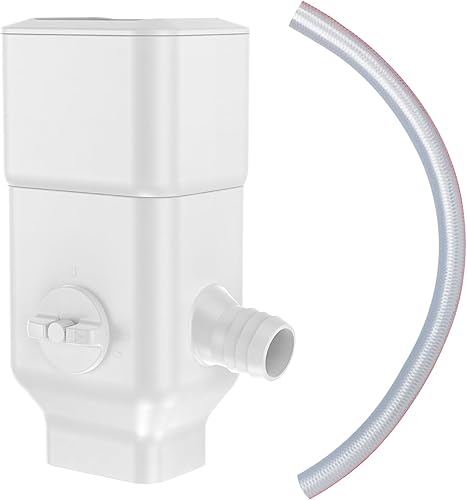
If you have significant tree canopy overhead, leaf debris will eventually clog any diverter. The Fiskars DiverterPro is designed for this failure mode: when it clogs, water bypasses back to the original drain path rather than overflowing. From r/preppers, u/Iwatcher: “When the diverter gets clogged water continues down the existing drain. Hopefully it works, dealing with an overflowing rain barrel during a heavy rainstorm is a pain.”
Price: $25–$40
Setup Rules That Apply to Every System
No matter which barrel you choose, these apply:
Elevate your barrel. Even 12-18 inches of elevation creates enough head pressure for gravity-fed watering. Cinder blocks work. A wooden platform works. An IBC tote with railroad ties underneath it works. Without elevation, you’re scooping or pumping.
Use opaque containers. Algae needs sunlight. Dark or opaque barrels solve 90% of the algae problem. Clear IBC totes and translucent plastic barrels require exterior paint or black covers — not optional.
Install overflow before first use. This cannot be overstated. A barrel will fill faster than you expect. If overflow water routes toward your foundation, you’re looking at water damage. Route it to a rain garden, a swale, or at minimum back down the original downspout path.
If you have asphalt shingles, filter more carefully. As u/donnieCRAW noted on r/preppers: “IMO if you have asphalt composite shingles significant prefiltering should be done as well as the normal treatment methods.” Shingle particles and contaminants wash into the barrel with first-flush runoff. A first-flush diverter discards the initial dirty roof runoff before it enters storage — worth adding for edible garden use.
Drain before winter in freeze-prone climates. Frozen water expands and cracks barrels.
Comparison at a Glance
| Option | Capacity | Price | DIY Required | Best For |
|---|---|---|---|---|
| RTS 55-gal Premium | 55 gal | $100–$150 | Minimal | Easy setup, polished look |
| Good Ideas Rain Wizard | 50 gal | $90–$130 | Minimal | Visible/aesthetic placements |
| Food-Grade DIY Barrel | 55 gal | $25–$125 | Yes | Budget-conscious, daisy-chaining |
| IBC 275-gal Tote | 275 gal | $75–$150 | Yes | Serious volume, homesteads |
| EarthMinded Diverter | — | $15–$25 | Minimal | Standard leaf coverage |
| Fiskars DiverterPro | — | $25–$40 | Minimal | Heavy tree coverage |
The Bottom Line
Buy the IBC tote if you have the space and are willing to spend a few hours on setup. At $75–$150 used for 275 gallons, it’s genuinely hard to justify a $130 purpose-built barrel at one-fifth the capacity unless aesthetics are a hard requirement.
Buy the RTS 55-gallon if you want something that looks respectable, requires minimal assembly, and will actually be maintained — the removable lid matters more than most reviews acknowledge.
Go the DIY food-grade route if you’re on a budget and comfortable with basic plumbing. The community consensus on this is strong and consistent across every thread in the research.
Whatever you start with: install overflow on day one, keep the barrel opaque, elevate it, and check your local regulations first. Those four things matter more than the brand on the side.