Stop Overthinking Liquid Fertilizer: What to Actually Buy for Your Vegetable Garden
This article contains affiliate links — if you buy through them, we earn a small commission at no extra cost to you.
Some links in this article may earn a commission at no extra cost to you.
A thread on r/vegetablegardening titled “Overwhelmed by fertilizer options” got 22 upvotes and spawned 34 comments — nearly all of them saying some version of the same thing: you don’t need five products, the marketing is mostly noise, and the honest answer depends on three questions you probably haven’t been asked yet.
So let’s start there.
Answer These Three Questions First
1. Are you growing leafy greens or fruiting vegetables (tomatoes, peppers, squash)? Leafy crops want nitrogen. Fruiting crops want nitrogen early, then a shift toward phosphorus and potassium once they start flowering. A nitrogen-heavy fish emulsion is great for the first group and only half the story for the second.
2. Do you have dogs, cats, or wildlife pressure in your yard? Fish-based fertilizers work extremely well. They also smell like exactly what they’re made from. Multiple Reddit users flagged this — one noted that fish products can be “pretty attractive to your dog.” If this is a real concern, skip fish and go straight to a balanced organic liquid.
3. Do you want one product that handles everything, or are you okay managing two? Most home gardeners are better served by one solid all-purpose liquid than by a shelf of specialized products. u/recoil1776 on r/vegetablegardening (5 upvotes) gave what might be the most practical advice in any of the threads: “If I had to go with one, I’d be perfectly content with just buying a big jug of Agrothrive, or any other balanced organic liquid fertilizer.”
Your answers to those three questions route you to different products. Here’s what to buy.
If You Want One Product for Everything: AgroThrive General Purpose
AgroThrive General Purpose Organic Fertilizer Buy on Amazon (~$20–$35)
This is the recommendation for gardeners who want to stop thinking about fertilizer. Balanced NPK (roughly 3-3-2 to 5-3-4 depending on the batch) means it works on leafy greens, fruiting crops, herbs, and everything else — without switching products when your tomatoes start to flower.
u/recoil1776 on r/vegetablegardening described how they actually use it: diluted down for seedlings in trays, heavier for new transplants, and standard concentration on every plant during regular watering. No measuring, no burning, no drama.
u/Reduntu on r/vegetablegardening added: “I just started using AgroThrive general purpose organic fertilizer. Seems to have great reviews and to be good for the soil.”
Pros
- Balanced formula works across every vegetable type
- No burn risk — apply without precise measurement
- Feeds soil biology, not just the plant
- Liquid mixes easily into a watering can
Cons
- Less widely stocked in physical stores (primarily online)
- Not ideal if you need a targeted nitrogen or phosphorus push
Who it’s for: Anyone who wants one bottle for the whole garden. Particularly strong for container growers, where soil biology is limited and granular slow-release products don’t break down efficiently.
If You’re Growing Leafy Greens or Need a Fast Nitrogen Boost: Alaska Fish Fertilizer

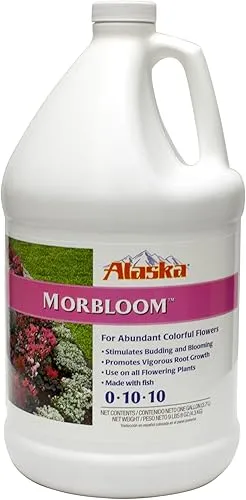
Alaska Fish Fertilizer 5-1-1 Buy on Amazon (~$10–$20)
The workhorse recommendation. It appears in nearly every fertilizer thread on r/vegetablegardening and r/gardening — consistently, from experienced growers who have tried multiple products. The 5-1-1 NPK is deliberately nitrogen-heavy, which is exactly what leafy greens and green-up situations call for.
u/kawaiimeeshe on r/gardening (9 upvotes) put it plainly: “I love using Alaska brand fish fertilizer, it stinks but the plants love it! And it’s organic. Can pick it up at the big box home improvement stores.”
The immediately bioavailable nitrogen is the key feature here. Unlike granular organics that need soil microbes to break them down over weeks, Alaska Fish goes to work fast — which is exactly what you want when heavy rain has flushed your raised beds or container plants are yellowing.
u/asexymanbeast on r/vegetablegardening described using it as one of two primary liquid fertilizers alongside seaweed extract — a pairing multiple experienced gardeners mentioned independently.
Pros
- High-nitrogen (5-1-1) drives fast leafy growth and greening
- Immediately bioavailable — works within hours, not weeks
- True organic; feeds soil biology
- Available at Home Depot, Lowe’s, and most hardware stores
- Very low burn risk
Cons
- Strong odor attracts dogs and other animals
- Lopsided NPK — not suitable as a standalone fertilizer for tomatoes, peppers, or other fruiting crops
- You’ll need supplemental P and K if using this as your only liquid for fruiting vegetables
Who it’s for: Lettuce, kale, spinach, chard — any leafy crop. Also excellent for rescuing yellowing plants fast after heavy rain, or mid-season greening when nitrogen has leached out.
If You Want the Premium Fish Option: Neptune’s Harvest Fish & Seaweed

Neptune’s Harvest Fish & Seaweed Fertilizer Buy on Amazon (~$20–$35)
Neptune’s is what experienced organic gardeners recommend when they’ve moved past basic fish emulsion. The difference matters: Alaska Fish Fertilizer is a fish emulsion (heat-processed), while Neptune’s is a fish hydrolysate (cold-processed). Cold processing retains more amino acids, enzymes, and micronutrients that the heat drives off. If you’re feeding heavy feeders like tomatoes and peppers, that fuller nutrient profile is real.
u/Vidco91 on r/vegetablegardening specifically recommended the hydrolysate route: “Use a good fish hydrolysate — Neptune Harvest, Organic Gem, Pacific Gro.” The fish + seaweed blend adds kelp-derived micronutrients and plant growth hormones on top of the base fish nutrition.
Multiple independent commenters across different threads mentioned Neptune’s by name — not as a paid mention, but as the product they actually use.
Pros
- Cold-processed hydrolysate retains more amino acids and micronutrients than emulsion
- Fish + seaweed blend covers a broader nutrient spectrum
- Consistently recommended by experienced organic gardeners
- Suitable for heavy-feeding fruiting crops
Cons
- Still smells like fish — pet and wildlife pressure applies here too
- More expensive than Alaska Fish Fertilizer
- Mainly available online rather than at big-box stores
Who it’s for: Organic gardeners who want to step up from basic fish emulsion, especially those growing tomatoes, peppers, eggplants, or other heavy feeders who want the fuller nutritional profile of hydrolysate.
If You Want a Stage-Specific Feeding Program: Fox Farm

Fox Farm Liquid Fertilizer Line Buy on Amazon (~$20–$40)
Fox Farm comes up in Reddit threads with something closer to brand loyalty than product recommendation. u/wanderingplanthead on r/gardening (10 upvotes): “Miracle grow is gross. I use fox farm for all my edible plants.” Another commenter added simply: “Read through fox farms offerings. I love them.”
The Fox Farm lineup is built around a tiered approach — different products target different growth stages (vegetative growth, bloom, fruiting) rather than a single all-purpose formula. That makes it more complex to use than a one-bottle solution, but more precise for growers who want stage-specific nutrition.
Pros
- Strong brand loyalty among experienced container and raised-bed growers
- Multiple products targeting specific growth stages
- Suitable for a serious feeding program for tomatoes and peppers
Cons
- Reddit users reference the brand without naming specific SKUs — harder to know which product to start with
- Generally only available at nurseries, not big-box stores
- Higher price point overall
Who it’s for: Growers who want a dedicated grow/bloom/micro program and are comfortable managing multiple products. Not a beginner recommendation.
The Synthetic Option (and Why It’s Complicated): Miracle-Gro

Miracle-Gro Water Soluble All Purpose Plant Food Buy on Amazon (~$10–$20)
The performance results are not in dispute. In a YouTube experiment by Christina at Forever Food Forest, Miracle-Gro produced the largest, greenest plants of any fertilizer tested — synthetic, organic, or homemade. It’s cheap, it’s everywhere, and it works fast.
The problem she documented was equally clear: “Miracle Grow performed best across the board… but there was one disadvantage, and that is pest pressure.” The Miracle-Gro plants attracted significantly more pests than organically fertilized ones.
Her analogy stuck: “Using the synthetic fertilizers is like living off of protein powder and steroids. You’re going to bulk up fast, but it’s going to be at the cause of your overall health.”
The Reddit community is largely hostile to it for vegetable gardens — not because it doesn’t grow plants, but because repeated use degrades soil health, builds up salts, and doesn’t feed the biology that makes soil productive long-term. The consensus is: it’s a fine rescue product in a pinch, not a soil-building strategy.
Pros
- Fastest visible results
- Cheapest per-application cost
- Available absolutely everywhere
- Works within 24 hours
Cons
- Does not feed soil biology
- Repeated use degrades soil health and builds salt
- Attracts more pest pressure than organic options
- Can burn plants if applied to dry soil or mixed too strong
Who it’s for: Honestly, not recommended as a primary fertilizer for organic or health-conscious vegetable gardeners. If you’re growing in a controlled greenhouse setting where soil biology isn’t the goal, or you need a one-time fast rescue, it works. For a long-term home garden, it’s the wrong tool.
The Add-On Worth Considering: Kelp/Seaweed Extract

Liquid Kelp / Seaweed Extract Buy on Amazon (~$10–$25)
Kelp extract is not a standalone fertilizer — the NPK is too low to sustain plants on its own. But as a companion to fish emulsion or any nitrogen source, it fills in micronutrients and plant growth hormones that NPK-only products miss.
u/asexymanbeast on r/vegetablegardening described using Alaska Fish Emulsion and seaweed extract together as their “primary liquid fertilizers” — a combination that multiple experienced gardeners landed on independently. The Neptune’s Harvest Fish & Seaweed blend essentially packages this combination into one bottle if you’d rather not buy two products.
If you’re already using Alaska Fish Fertilizer and want to round out your program without stepping up to a full balanced liquid, adding kelp extract is a low-cost way to cover micronutrients and foliar application.
The Practical Cheat Sheet
| Situation | Buy This |
|---|---|
| Want one product for everything | AgroThrive General Purpose |
| Leafy greens or fast nitrogen rescue | Alaska Fish Fertilizer |
| Heavy feeders, want the premium option | Neptune’s Harvest Fish & Seaweed |
| Tiered stage-specific program | Fox Farm lineup |
| Already have fish emulsion, want micronutrients | Add kelp/seaweed extract |
| Have dogs or wildlife pressure | AgroThrive (no fish smell) |
A Few Things the Reddit Community Agrees On
Start with compost. Liquid fertilizers are mid-season boosters on top of healthy soil, not replacements for it. u/Asterlane on r/vegetablegardening (5 upvotes, 30+ years experience) kept it simple: “I use a bagged organic all-purpose garden fertilizer and liquid fish + kelp to dilute for ‘booster’ doses midseason.” That two-part system — solid foundation, liquid booster — is the model that comes up again and again.
Apply every 1–2 weeks with organics. Monthly intervals caused visible fading on tomatoes in one grower’s documented experience. Organics work more slowly and need regular reapplication to maintain effect.
Switch your NPK ratio at flowering. High nitrogen drives the leafy growth you want in early season. Once tomatoes and peppers start to flower, back off nitrogen and prioritize phosphorus and potassium for fruit set. This is where fish emulsion (5-1-1) shows its limitation as a solo product — it’s great for vegetative growth but doesn’t support the transition to fruiting.
Containers need liquid more than in-ground beds. There’s less soil biology in a container, granular slow-release products don’t break down as efficiently, and heavy watering flushes nutrients out faster. If you’re container gardening, liquid is the right call.
If you read nothing else: buy AgroThrive if you want one product that works on everything without thinking about it. Buy Alaska Fish Fertilizer if you’re primarily growing leafy greens or need cheap, effective nitrogen that’s available at Home Depot. Buy Neptune’s Harvest if you’re serious about organic heavy feeders and want the better-processed fish product. Skip the Miracle-Gro for a vegetable garden you’re trying to build over time.
That’s really it.