Landscape Fabric Actually Works — You're Just Buying the Wrong Kind
This article contains affiliate links — if you buy something, we may earn a small commission at no cost to you.
Every gardening forum has the same argument: “Landscape fabric is garbage, don’t bother.” And they’re right — about one specific type. The perforated stuff filling entire aisles at Home Depot and Lowe’s genuinely doesn’t work. But write off the whole category and you’ll miss that woven landscape fabric is a completely different product with a completely different track record.
The single most important thing to understand before buying any landscape fabric is this: how it’s made determines whether it works at all.
The Two Products That Share a Name
Walk into any big-box store and pick up a roll of landscape fabric. Odds are you’re holding perforated or needle-punched fabric — it looks almost like stiff fiberglass cloth, with tiny holes punched through it. The theory is that water passes through those holes while blocking weeds. In practice:
“This thing was covered with weeds — dandelions, crabgrass. It didn’t get one year of usage before it would have to be replaced.”
That’s not an isolated experience. Those tiny perforations fill with soil, decomposed mulch, and windblown debris within months. Once they’re clogged, water can’t reach your soil. Oxygen can’t reach your soil. Your plants slowly struggle while weeds — which don’t care about any of that — root directly into the fabric itself, making removal a nightmare. You end up with a product that’s actively killing your garden bed while failing to stop weeds.
Woven landscape fabric works differently. Instead of punched holes, it’s constructed from interlaced fibers with micro-gaps across the entire surface. Those gaps don’t clog because there’s no discrete hole to fill — water and oxygen pass through the whole sheet, continuously. Weeds can’t root through the tight weave.
One landscape professional who tested both types side-by-side put it plainly: “One year later — there is nothing attached to it, there’s nothing growing underneath it, the soil is active, it’s rich. It’s as if I put it down yesterday.” He followed that with a direct message to skeptics: “If you’re a landscape professional and you believe landscape fabrics are garbage, I believe you’re talking about perforated fabric. I encourage you to go look at woven fabric.”
What to Actually Buy
Note: Reddit data wasn’t available for this category — findings here are based on YouTube reviews and professional testing. Pricing data was also unavailable; check current listings for costs.
The One We Can Actually Recommend

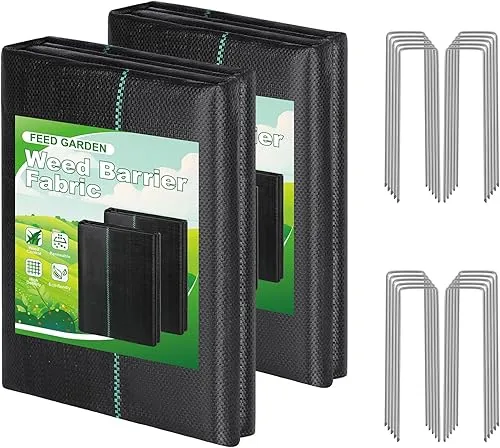
VEVOR Weed Barrier Fabric Heavy Duty 5.8oz Woven Buy on Amazon
The VEVOR 5.8oz woven fabric is the only specific brand a reviewer tested and reported back on. After doing what sounds like the same research you’re doing right now — comparing brands, reading reviews, watching videos — they landed here. Key early-use findings:
- Water drains through it freely, even immediately after heavy rain
- Comes with 12-inch spacing markers pre-printed, which is a small but genuinely useful detail for keeping rows straight
- Available in widths from 3ft to 15ft and lengths up to 300ft, so you can match your actual garden dimensions without awkward seams
- The black color did not cause heat problems for plants, even in Texas summers — a common concern that reviewers consistently describe as a non-issue in practice
The main caveat: this is an early-use report, not a multi-year test. What we can say with confidence is that the construction (heavy-duty woven at 5.8oz) matches what landscape professionals describe as the durable type.
What to Look for If You Buy Elsewhere
If you can’t find VEVOR in the dimensions you need, the guidance from professionals is that the type matters more than the brand. When shopping any supplier, look for:
- “Woven” explicitly in the product name or description
- Weight of 4–6oz per square yard or higher — heavier generally means more durable
- A texture that looks like tightly interlaced fibers, not punched holes or felt-like material
Avoid anything described as “needle-punched,” anything with a fiberglass-like texture, and anything that feels like the stuff at the end cap at your local hardware store. If the listing doesn’t clearly say “woven,” assume it’s the perforated type and keep looking.
What Not to Buy
Standard Perforated Landscape Fabric — skip it entirely
It’s cheap, it’s everywhere, and it consistently fails within a year. If someone tells you landscape fabric doesn’t work, this is what they tried. The only scenario where it might be acceptable: a temporary, single-season use where you’re pulling it up at the end of the year anyway. For anything meant to last, it’s the wrong tool.
How to Choose the Right Specs
Once you’ve confirmed you’re buying woven fabric, a few additional factors matter:
| Factor | What to Look For |
|---|---|
| Weight | 4oz minimum; 5–6oz for high-traffic or long-term installs |
| Width | Match your bed width to minimize overlapping seams |
| Length | Buy a single roll to cover your area — seams are weed entry points |
| Application | Under hardscape/gravel: any woven weight works. Garden beds: go heavier |
The Bottom Line
Most landscape fabric fails because most landscape fabric sold at big-box stores is perforated — and perforated fabric clogs, tears, and lets weeds root through within a season. Woven fabric, built differently at the construction level, maintains drainage and weed suppression over multiple years.
If you want to buy once: look for the VEVOR 5.8oz woven or any heavy-duty woven fabric from a reputable supplier. Check the weight, confirm the construction is woven (not needle-punched), and buy a width that covers your area in one pass.
The gardening forum consensus that “landscape fabric doesn’t work” is really just a consensus that the perforated stuff doesn’t work. It’s the right conclusion about the wrong product.