Which Hori Hori Should You Buy? Answer These Three Questions First.
This article contains affiliate links — if you buy through them, we earn a small commission at no extra cost to you.
“I have rocky soil too, and I have snapped a couple other brands, but not the Barebones.”
That Reddit comment captures why hori horis have a devoted following — and why buying the wrong one actually matters. Unlike a cheap trowel you can replace at a garden center for $8, a hori hori is something people expect to keep for a decade. When it snaps in hard clay, it’s not just annoying. It’s a betrayal.
Before getting into the picks, one honest caveat: the hori hori is a great weeder and an okay transplanting aid. It is not, despite what every product listing implies, “the most useful gardening tool.” It won’t replace your pruners, it’s a poor substitute for a bulb planter, and it won’t move dirt the way a spade does. Where it genuinely shines is plunging deep after tap-rooted weeds — dock, thistle, dandelion — where its narrow blade gives you leverage a trowel never could. If that’s your problem, read on.
Answer These Three Questions
1. What’s your soil like?
If you garden in rocky or clay-heavy soil, full-tang construction is non-negotiable. The blade-to-handle joint is the first failure point, and cheap partial-tang knives snap under lateral stress in hard ground. Budget models — and most no-name Amazon listings — cut this corner. Don’t buy one for tough soil.
If your soil is loose and loamy, almost any decent brand will hold up, and you have more flexibility on price.
2. How much do you actually maintain your tools?
Carbon steel takes a sharper edge, holds it longer, and sharpens more satisfyingly than stainless. Gardeners who appreciate tools tend to prefer it. The trade-off is that it will rust if you leave it wet — which means wiping it down after use and occasionally oiling the blade.
If that sounds like the version of yourself you aspire to be rather than the version you actually are, buy stainless. A stainless hori hori left in a garden bed will survive. A carbon steel one will not.
3. Is this for you, or is it a gift?
Some tools are beautiful objects. Others are just workhorses. The hori hori market has both. The answer to this question changes which one to buy.
The Picks
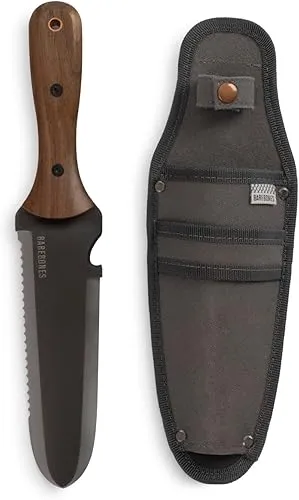
Rocky Soil / Serious Gardener: Barebones Classic Hori Hori (~$35–$60)
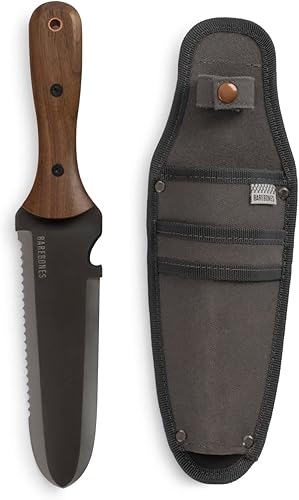
The Barebones is the most-cited recommendation in BIFL gardening threads, and the reasoning is consistent: it survives conditions that snap other knives. Multiple users specifically mention rocky soil as the test case it passes.
The handle is a meaningful differentiator — Barebones’ rounded grip is routinely praised in direct comparison to competitors’ flatter handles, which develop hotspots during extended weeding sessions. If you’re clearing a border with 50+ weeds, that matters.
The sheathed version costs a bit more but is worth considering. Several gardeners mention leaving trowels and knives stuck in borders; a sheath gives the tool a consistent home and keeps it from getting lost in mulch.
Mid-Range / Japanese-Made: Nisaku Hori Hori TM-650 (~$25–$45)

The Nisaku occupies the sweet spot between price and pedigree. It’s Japanese-made, the steel holds an edge well, and it resharpens easily — one user described using theirs for three-plus years through “some nasty terrain” with no complaints. Community sentiment is unambiguously positive, though it draws less conversation than Barebones simply because fewer people seem to own one.
If the Barebones is out of stock or you want to keep cost down without dropping to budget territory, the Nisaku is the call.
Gift Pick: Niwaki Hori Hori (~$40–$55)
The Niwaki is the most visually striking of the bunch. One YouTube reviewer described his wife’s reaction: “She went — whoa, cool. It looks like a fictional knife, it could be from His Dark Materials or Lord of the Rings.” The carbon steel blade, the sheath included in the box, the careful packaging — it reads as intentional in a way most garden tools don’t.
That said, the handle has a real flaw: the tang edges aren’t smoothed, which creates a pressure point if you’re using it for long sessions. It’s a workable tool, not just a pretty one, but the handle is a step behind Barebones for all-day comfort.
If you’re buying this for yourself: get Barebones or Nisaku. If you’re buying it as a gift for someone who appreciates well-made objects, Niwaki is genuinely worth the premium.
What About Fiskars?
Fiskars makes tools people trust for good reason — their pruners and loppers have a strong reputation. The Fiskars hori hori is a reasonable entry point if budget is tight and easy returns matter to you. Community sentiment is mixed, with at least one BIFL user noting inconsistent quality across their tool line. It’s not a bad knife, but it’s not the buy if you’re in rocky soil and want something to last a decade.
Quick Reference
| Barebones | Nisaku | Niwaki | Fiskars | |
|---|---|---|---|---|
| Price | $35–$60 | $25–$45 | $40–$55 | $20–$35 |
| Steel | Stainless | Japanese steel | Carbon | Stainless |
| Rocky soil | ✓ Proven | ✓ Confirmed | Not specifically tested | Avoid |
| Handle comfort | Excellent | Good | Flat / basic | Unknown |
| Sheath included | Optional | No | Yes | No |
| Best for | Durability-first | Value + quality | Gifts / craft-focused | Budget / easy return |
The One Thing to Remember
Expect to sharpen it. The grit that makes your soil hostile to weeds will also dull the blade. A sharp hori hori slips into the ground with almost no effort; a dull one is barely better than a stick. If sharpening sounds like a chore, carbon steel (Niwaki) will frustrate you — it dulls faster and requires more care. Stainless holds up with less attention.
Bottom line: Buy the Barebones if you’re in rocky or clay soil. Buy the Nisaku if you want Japanese-made at a lower price. Buy the Niwaki if it’s a gift or you care about having a beautiful tool. Skip the no-name Amazon options entirely.