Before You Buy a Seed Starting Heat Mat, Answer These 3 Questions
Heads up: some links below are affiliate links. GardenVerdict earns a small commission on qualifying purchases, at no extra cost to you.
GardenVerdict earns a small commission on purchases made through links in this article, at no cost to you.
It’s 3am in a cold Nebraska basement, and Mark Kelly’s pepper seeds have been sitting on a 55°F concrete floor for two weeks — no germination. Peppers want 80°F+ to sprout. The basement can’t deliver that. A heat mat can.
But here’s the thing: a huge chunk of people who buy heat mats for seed starting either don’t need one, or buy one and use it wrong. Cool-season crops — lettuce, spinach, kale, broccoli, peas — can actually be pushed into dormancy by the extra heat. And even for warm-season crops, a mat without a thermostat is just a guess.
So before we talk about which mat to buy, let’s figure out if you need one at all.
Question 1: What are you growing?
This is the only question that really matters first.
Use a heat mat for: peppers, tomatoes, eggplant, cucumbers, basil, oregano, marigolds, zinnias, and most Mediterranean herbs. These crops need soil temps of 75–85°F to germinate reliably — often more than a cool indoor room can provide.
Do NOT use a heat mat for: lettuce, spinach, kale, broccoli, dill, cilantro, peas, beans, carrots, pansies, or snapdragons. Excess heat pushes cool-season crops into dormancy or blocks germination entirely. This is a hard stop.
As the Bootstrap Farmer channel explained in their heat mat masterclass: “A lot of your cool season crops like spinach, carrots, kale, broccoli, lettuce — if they have any heat whatsoever, that’s going to put those seeds in a dormant mode and you’re not going to get any germination.”
If you’re only growing cool-season crops this spring, put the $15 back in your pocket.
Question 2: How warm is your grow space?
If your indoor grow space stays 68–72°F consistently, most warm-season seeds will germinate just fine without a mat. It might take a few extra days, but you’ll get there.
A heat mat earns its keep when your ambient temperature drops below 65°F regularly — a garage, basement, shed, or drafty room. u/randomusername1919 on r/gardening put it plainly: “Works for me because I keep my house rather cool, 65-68°F. The seed heat mats keep the seeds in the optimal germination range. I also have a thermostat that I can set and it has a probe to the dirt.”
One important ceiling to understand: heat mats raise tray temperature 10–20°F above ambient — and realistically, count on 10°F. If your garage is 50°F, you’re hitting 60°F, which is still too cold for peppers (they want 80°F+). In very cold unheated spaces, you need to combine a mat with a humidity dome or mini-greenhouse enclosure. The mat alone won’t overcome a 40°F room.
Question 3: How many trays are you running?
One or two trays? Any standard 10×20 mat works.
Multiple trays simultaneously? Look at linkable systems or multi-packs. The math changes fast when you’re running 10–20 trays at a time — a scalable solution costs less per tray and creates fewer cord management headaches.
If You’re Buying: The Four Options Worth Considering
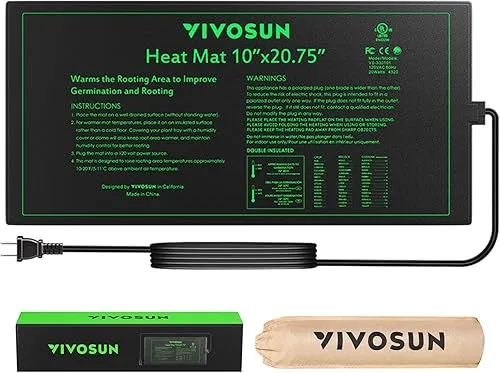
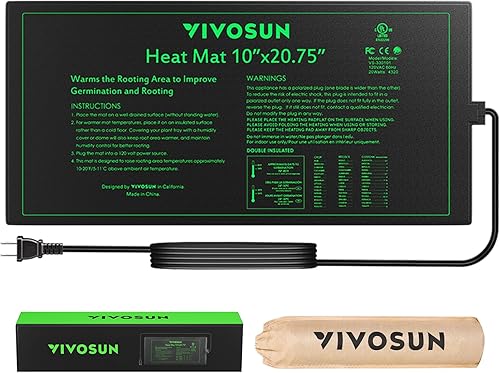
Best All-Around: Vivosun Seedling Heat Mat (10×20.75”, 20W)
Price: $12–$20
The community’s most-cited mat across multiple subreddits, and the durability reports are unusually consistent. u/manyamile on r/vegetablegardening summed it up: “I use a bunch of Vivosun mats with the thermostat that are on year 5 now. I use them on my seedling racks in the garage and also keep a couple in a 100-gallon tub for my composting worms. They’re fine.”
That kind of longevity at this price point is what earns a mat its reputation on gardening forums. Vivosun also offers multiple sizes beyond the standard 10×20, which makes scaling easier.
Pros:
- Proven 5+ year durability reported by multiple users
- Reliable heat output confirmed across r/gardening, r/vegetablegardening, r/Permaculture
- Pairs cleanly with external thermostats (Inkbird, etc.)
- Available in multiple sizes
Cons:
- No built-in thermostat — you’re running at a fixed heat output
- One user reported an inaccurate mat and a frustrating warranty exchange
- Like all basic mats, ineffective in very cold (sub-55°F) rooms without an enclosure
Bottom line: The safe default. Pair with an Inkbird thermostat and you have a proper seed starting station.
Best Budget Pick: BN-LINK Durable Seedling Heat Mat (10×20.75”, 20W)

Price: $10–$18
BN-LINK’s mat showed up in a Mark Kelly Farm homesteading video (sponsored, so weight that accordingly) and in a r/houseplants thread where a user had practical hands-on experience. The distinguishing features at this price: waterproof construction, a 4-foot cord that reduces extension cable needs, and germination day estimates printed right on the mat — a small but useful touch.
Mark noted the electricity draw: 20W ÷ 120V = 0.16 amps. Running four of these mats barely registers on a standard 15-amp circuit.
The one real caution came from user bunnylicious81 on r/houseplants: “I placed a towel between the mat and the plants & propagation boxes so that not too hot. With towel, about 90°F. Since it doesn’t have a built-in thermostat, I put a portable thermostat on it.”
That’s not a dealbreaker — it’s standard practice — but it illustrates why every mat in this category needs a thermostat to be truly dialed in. BN-LINK also sells a 4-pack, which makes it attractive if you’re starting a lot of trays on a budget.
Pros:
- Waterproof
- 4-foot cord is practical
- Germination day estimates printed on mat
- Available in 20×20.75” (40W) and 48×20.75” (105W) versions
- Very low electricity draw
Cons:
- No thermostat — can overheat propagation boxes without a buffer
- YouTube source was sponsored
Best for Scaling Up: Bootstrap Farmer Heat Mats (Hobby + Commercial Lines)
Price: $25–$45 (hobby 10×20); $80–$150 (commercial linkable system)
Bootstrap Farmer is where you go when you outgrow a couple of Vivosun mats. Their hobby line covers a standard 1020 tray, but the commercial linkable system is what sets them apart: a 21×60” master mat plugs into the wall, and up to three add-on mats chain off it. As their YouTube channel explained: “You can have one master and three add-ons for a total of four mats — that’s enough for 20 1020 trays at one time.”
All Bootstrap Farmer mats are waterproof, UL listed, and come with 6-foot cords. They’re designed specifically for paired use with a thermostat — the commercial line makes this explicit. The source here is Bootstrap Farmer’s own channel, so factor in promotional intent, but the product specs are verifiable and the use case is clearly defined.
This isn’t the pick for a hobbyist doing two pepper trays. It’s for market gardeners, serious homesteaders, or anyone who’s already outgrown the basic setup.
Pros:
- Linkable commercial system scales cleanly (1 master + 3 add-ons = 20 trays)
- Waterproof, UL listed, 6-foot cords
- Designed for thermostat pairing
- Hobby line available in standard 1020 size
Cons:
- Significantly more expensive than budget options
- Commercial system requires purchasing master + add-on units separately
- YouTube source is the brand’s own channel
Recognizable Brand Option: Hydrofarm Seedling Heat Mat (17W)
Price: $15–$25
Hydrofarm has been in horticulture for decades and is sold at many garden centers. It does what it says: raises tray temp 10–20°F above ambient, low wattage, low energy cost. u/DLiltsadwj on r/vegetablegardening noted: “My seedlings were getting a little too hot for me so I insulated the seedling tray from the heating mat with a sheet or two of newspaper.”
That’s not a failure — it’s normal mat behavior without a thermostat. The honest assessment: Hydrofarm works, but nothing about it justifies paying more than Vivosun or BN-LINK unless you specifically want the brand name or it’s the only one in stock locally.
Pros:
- Established horticulture brand
- Reliable 10–20°F temp raise as advertised
- Low wattage
Cons:
- No thermostat
- Nothing that differentiates it from cheaper options
- Can overheat without a buffer layer
How They Stack Up
| Mat | Price | Thermostat | Waterproof | Cord Length | Best For |
|---|---|---|---|---|---|
| Vivosun 10×20 | $12–$20 | No | No | Standard | Most home gardeners |
| BN-LINK 10×20 | $10–$18 | No | Yes | 4 ft | Budget buyers, multi-packs |
| Bootstrap Farmer Hobby | $25–$45 | No (designed for it) | Yes | 6 ft | Serious hobbyists |
| Bootstrap Farmer Commercial | $80–$150 | No (paired) | Yes | 6 ft | Market gardeners, 10+ trays |
| Hydrofarm 17W | $15–$25 | No | No | Standard | Brand name preference |
The One Upgrade That Actually Matters: Add a Thermostat
Every mat in this category is a dumb heater. No thermostat, no feedback loop — just constant heat output. That’s fine for many setups, but it introduces real risk for seeds with narrow germination windows.
The fix is a separate thermostat with a soil probe — something like an Inkbird ITC-308 or similar. The probe sits in the growing medium and cycles the mat on/off to hold a tight 3–4°F window around your target temperature.
u/solitude042 on r/Permaculture explained exactly why this matters: “I use some vivosun mats (which produce plenty of heat) and an inkbird temperature probe — that way, I can accurately dial the temp in to a very small range, and be measuring the actual soil temp. It’s particularly useful when switching between cloches for initial seed starts vs. open for seedling growth — the cloche traps more heat, so the temp probe was essential to prevent overheating.”
Without a soil probe, you’re measuring air temperature and guessing at what’s happening in the medium. With one, you’re running a controlled germination environment.
Four Things to Do (and Not Do) Once You Have a Mat
Insulate from concrete and metal. Cold surfaces draw heat out of the mat. A piece of foam board underneath makes a measurable difference in effective output.
Add a humidity dome. It traps heat and moisture simultaneously, reducing how much the mat has to work and improving germination rates.
Pull the mat at 75% germination. The Bootstrap Farmer video made this explicit: once most of your seeds have popped, the heating-up process is done. Leave the mat on longer and you’re just stressing the seedlings.
Watch tomatoes especially. u/junior_primary_riot on r/gardening: “Makes tomato seedlings go leggy pretty quick though so they don’t get any heat mat or heat only until I see someone poking up and then they are off all heat.” Tomatoes are the most impatient crop when it comes to heat mat exit timing. Pull them the moment you see emergence.
The Short Version
If you’re growing peppers, tomatoes, eggplant, basil, or similar warm-season crops in a space that stays below 65°F, a heat mat is a genuine upgrade — not hype. At $12–$20, a Vivosun 10×20 paired with a soil probe thermostat is the setup most gardeners land on and stick with for years.
If you’re running cool-season crops, growing in a warm room, or just starting out, skip it for now. Watch what germinates without one, then decide based on actual results.
The mat is for germination only. Once your seeds are up, remove it.