Your Shovel Didn't Break. You Were Using the Wrong Tool.
This article contains affiliate links. We may earn a commission if you purchase through them, at no extra cost to you.
Here’s a recurring thread on r/BuyItForLife: “My [insert brand] shovel snapped in half digging out a stump, what’s a better one?” And buried in the replies, inevitably, is someone pointing out the shovel wasn’t the problem — the task was.
Using a round-point shovel to pry out root balls is like using a chef’s knife to open a package. The tool’s fine. You just needed a different one. Once you understand that, the path to buying the right digging tool gets a lot cleaner.
Spade vs. Shovel: The Distinction That Actually Matters
Before any product recommendations: shovels and spades are different tools for different jobs.
- Shovel — curved, angled blade. Good for scooping, moving loose material (soil, mulch, gravel), and general digging.
- Spade — flat, straight blade. Good for cutting sod, edging beds, opening clean-sided trenches, and slicing through roots.
Most people buying a “garden shovel” actually need a spade. If you’re planting shrubs, dividing perennials, or edging a bed, you want a flat blade that cuts rather than scoops. If you’re moving compost from a pile, you want the curved shovel.
Got that? Now answer these two questions:
1. What’s your soil like? Rocky, root-dense, clay-heavy soil with established plants demands a heavier, stronger tool. Soft amended garden beds do not.
2. What are you actually doing? Planting/hole-digging → narrow spade or round-point shovel. Edging/sod-cutting → flat spade. Root and stump removal → serrated blade or all-steel heavy spade. Loose material transfer (mulch, compost) → a transfer shovel, not a digging tool at all.
Your answers should point you to one of these four options.
If You’re Digging Out Established Shrubs, Roots, or Stumps
A.M. Leonard All Steel Nursery Spade / Drain Spade — ~$97

This is the shovel that professional landscapers cite by name when someone asks what to buy. And the reason is simple: it’s built like the work it’s designed for.
The handle is all steel — not fiberglass, not wood. The cross-section is oblong-to-round specifically engineered to resist lateral flex where stress concentrates when you lever back against a root ball. The blade is 12-gauge steel versus the ~16-gauge you’ll find on standard shovels. The boot ledge is wide and substantial.
One user on r/BuyItForLife put it plainly: “I weigh 230 pounds and when I’m digging up one of these azaleas I can pretty much step back and put my entire weight on that 48-inch handle and not bend the shovel.” Another: “I have an A.M. Leonard all steel drain spade that will last 3 lifetimes.”
It does have real trade-offs. At 6.7 lbs it’s noticeably heavier than a standard 3-4 lb shovel, which adds up fast if you’re moving large volumes of loose material. It’s also ~$97, so it’s a genuine investment. But for the specific job it’s designed for — heavy root work, stump removal, prying out established plantings — nothing in this price range touches it.
If You Want All-Metal Durability Without the Premium Price
Fiskars Pro Digging Shovel / Drain Spade — ~$40–$70

The word “Fiskars” usually means consumer-grade garden tools, but their Pro line is a different product. All-metal construction, ergonomic blade angle, widely available at most US hardware stores and some EU markets. It’s not in the same weight class as the A.M. Leonard for hardcore root work, but it’s a meaningful step up from fiberglass handles for a home gardener who wants something that won’t snap.
“Fiskars makes a pretty good, all metal, long handled round point shovel,” one commenter noted — the praise is practical rather than enthusiastic, which is honest. The rounded spade blade is less ideal if you need clean edging cuts, but for general digging and planting it handles well.
If you’re a home gardener doing moderate work — seasonal planting, light root cutting, bed preparation — and you don’t want to spend $100, this is the smart choice.
If Your Soil Is Full of Roots and You’re Tired of Fighting It
Radius Garden Root Slayer Shovel — ~$60–$90
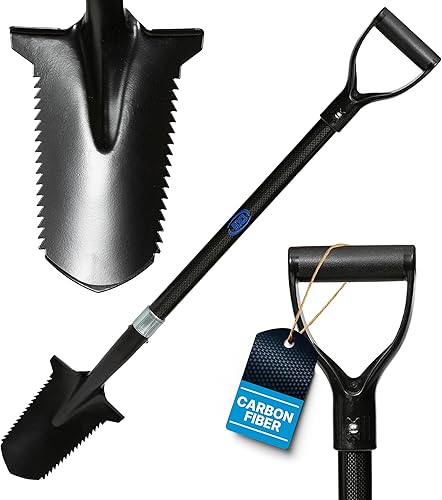
The Root Slayer is a specialized tool, and it’s worth being clear about that. The narrow serrated blade is designed to cut through roots on the downstroke — you don’t need a separate hatchet or loppers for fibrous root systems. It also works well as a planting tool for digging individual holes in compacted ground.
What it’s not: a general-purpose shovel. The narrow blade moves dirt slowly. Don’t buy this to transfer mulch or prep a raised bed; buy it if your garden is fighting back every time you try to plant something.
Users who have the right use case are almost evangelical about it. “We bought one, thinking ‘gosh, that’s expensive for a shovel’ — we use it almost exclusively and constantly, and it rips through everything, gets boulders out of the ground.” The serrated blade wears slowly but users report no performance drop even with sustained use.
If You Want the Best Available and Plan to Use It Hard for 30 Years
King of Spades — ~$100–$150

The King of Spades comes up in Buy It For Life discussions as the benchmark others get compared against — “literally a lifetime tool” is a common characterization. It shows up less as a product people have reviewed in detail and more as a name serious gardeners drop when asked what the ceiling is.
The honest caveat: the same community members who cite it often note that A.M. Leonard and Gemplers make comparable all-steel spades at 30–40% less. If you want to know you bought the best and plan to pass it to your kids, King of Spades. If you want excellent-but-not-absolute-peak at a better price, the A.M. Leonard gets you 90% of the way there.
What to Avoid
Fiberglass handles for heavy prying or root work. Multiple users report these failing faster than expected under lateral stress. They’re fine for light digging. For anything involving body weight on the handle, you want steel.
Cheap stamped-steel blades. The $20–30 big-box shovels use thinner gauge steel that bends under serious load. They’re adequate for light work. They’re not built for heavy use.
Oversized blades. Bigger isn’t faster — an overfull scoop of dense clay causes fatigue quickly. Match blade size to what you can move comfortably per stroke.
The wrong blade shape for the task. Using a square transfer shovel to dig planting holes, or using a round-point shovel to edge a bed, is how tools get blamed for jobs they weren’t designed for.
A Quick Note on Blade Sharpening
Experienced users sharpen their digging tools the same way they sharpen kitchen knives — with an angle grinder or file. A sharp blade cuts through compacted soil and small roots cleanly instead of tearing. If you buy any of the tools above and aren’t sharpening the blade before hard use seasons, you’re leaving performance on the table.
The Short Version
| Situation | What to Get |
|---|---|
| Heavy root/stump work, professional-grade | A.M. Leonard All Steel Spade (~$97) |
| Home gardener, wants durability, budget-conscious | Fiskars Pro All-Metal (~$40–70) |
| Root-dense soil, lots of planting | Root Slayer (~$60–90) |
| Want the absolute best, no budget limit | King of Spades (~$100–150) |
| Occasional light digging in soft soil | Any $25–35 hardware store shovel |
For most serious home gardeners doing regular digging, planting, and some root work — the A.M. Leonard is what the community consistently points to, and the price-to-longevity math works out strongly in its favor. A $97 tool that lasts decades beats replacing $30 tools every few years.