The Plastic Bag Will Kill Your Plants — And Other Row Cover Lessons
This article contains affiliate links — if you buy through them, we earn a small commission at no extra cost to you.
Every spring, someone on r/gardening posts a photo of their dead tomatoes wrapped in transparent garbage bags, baffled by what went wrong. u/TableTopFarmer on r/vegetablegardening explained it as only someone who’s been there can: “When I was a gardening newbie, and expected a freeze, I carefully shrouded all my potted plants in transparent garbage bags. I was so proud of my proactive solution, but it was an astoundingly wrong one. Plastic has zero insulation ability, and the plants were frost killed everywhere they came into contact with the cover.”
That’s the first thing to understand about frost protection: plastic does nothing. Clear plastic bags, painter’s plastic, trash bags — all conduct cold directly to whatever they touch. Row covers work on an entirely different principle, and once you understand it, the whole product category makes sense.
How Row Covers Actually Work
The insulation in a row cover isn’t the fabric itself — it’s the trapped air. Spun-bonded polypropylene fabric creates a microclimate by slowing air movement and holding a pocket of warmer air around your plants. But that only works if there’s actual air between the fabric and the foliage.
u/wishbonesma on r/gardening put it clearly (5 upvotes): “The cloth is ineffective if it’s touching the plant. The point is to create an air buffer, so if the frost cloth is touching the plant, it’s just going to transfer the frost directly to the leaves as there’s no buffer.”
This is why wire hoops, tomato cages, or improvised PVC frames matter as much as the fabric itself. The cover drapes over the support structure; the plant lives in the warmer air beneath.
The Harvest to Table channel’s deep-dive on row covers confirms this, noting that lightweight fabrics (0.5–1 oz/sq yd) can raise temperatures 2–4°F above ambient, medium weight (1–1.5 oz/sq yd) adds 4–6°F, and heavyweight (1.5–2.5 oz/sq yd) provides 8–10°F of protection — but only if there’s airflow underneath. On sunny days, plastic tunnels can spike 30°F above ambient if not vented, which is why breathable fabric is almost always the right choice for plant-level coverage.
What Type Do You Actually Need?
Row covers serve three distinct jobs — and the biggest mistake is buying the wrong one for your situation.
If you need overnight emergency frost protection (light frost, 28–32°F): Almost anything breathable works. Cheap fleece from a fabric store, sheer curtains, old bed sheets. u/BunnyButtAcres on r/vegetablegardening offered the cheapest advice: “Cheap fleece from the fabric store… I just go pick out whatever fleece is cheapest. We’re in TX and rarely have a freeze last more than a day.” For 1–2 night coverage, there’s no reason to spend $30.
If you need weeks-long season extension or hard freeze protection (below 28°F): You need purpose-built spun polypropylene. Breathability matters when covers stay on for days — regular fabric traps moisture and leads to fungal rot.
If you want to keep insects off your crops all season: A lightweight breathable fabric (like Agribon AG-19) doubles as insect netting. u/gillyyak on r/pnwgardening summed up the experienced gardener’s approach: “I use two different weights of row covers: a frost blanket if we get an unexpected hard freeze in spring, and insect barrier on my cole crops (broccoli, cauliflower, etc) to keep the cabbage moths at bay.”
If you’re starting tomatoes or peppers early: Skip fabric entirely. Wall-O-Water outperforms any cover for individual warm-season plants, and the community is consistent on this.
The Products, Ranked by Use Case
Agribon / Spun-Bonded Row Cover Roll (by the roll)

This is the workhorse of the vegetable garden and the standard choice for anyone growing more than a few beds. Agribon (also sold under the DeWitt brand and various generics) comes in multiple weights: AG-19 is featherlight and passes 85–95% of sunlight, making it ideal for insect exclusion and light frost. AG-50 is heavyweight and blocks 50–70% of light but holds off serious cold.
The key insight from r/SquareFootGardening: Agribon goes out of stock when demand spikes, so buy it early. And if you’re price-sensitive, r/vegetablegardening users note that sheer curtains from a home goods store are a legitimate substitute — lighter on your wallet and sometimes more durable.
Pros
- Multiple weights for different jobs (one weight ≠ all situations)
- Lightweight grades (AG-19) allow 85–95% light transmission
- Works as insect barrier on cole crops season-long
- Reusable for multiple seasons, UV-stabilized versions last even longer
- Can be cut to any bed dimensions
Cons
- Heavier weights block significant light — leave them on too long and plants stunt
- Can go out of stock at peak demand
- Requires hoop infrastructure to use properly
Best for: Serious vegetable gardeners who want the right tool for each season — one weight for spring frost, a lighter grade for summer insect exclusion.
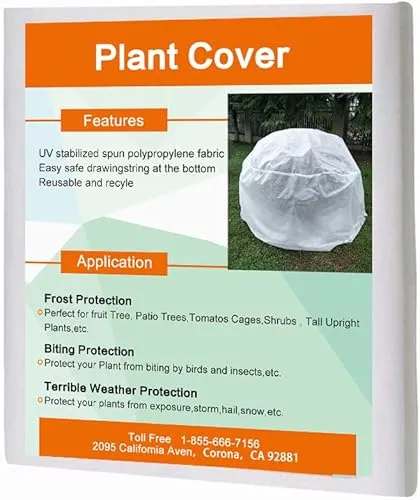
AG Fabric Plant Cover Frost Blanket

A pre-cut non-woven polypropylene blanket in the Agribon style, sized for home gardeners rather than market growers. This is the product to grab if you want a ready-to-use frost blanket without buying an entire roll. The breathable fabric lets air, water, and light through while creating the critical air buffer against frost.
The Harvest to Table review video notes that the AG Fabric blanket is well-regarded for lightweight flexibility: “Customer love the egg fabric plant cover for its lightweight design and ease of use. The breathable fabric ensures that plants stay protected without overheating.” The reviewer’s caveat is accurate: this is a mild-to-moderate frost cover, not a zone-5 hard-freeze solution.
Pros
- Lightweight and easy to deploy across multiple beds
- Breathable polypropylene — won’t overheat in mild conditions
- Can be cut to custom sizes
- Reusable season to season
- Lower upfront cost than buying a full roll
Cons
- Minimal insulation — rated for mild to moderate frost (28–32°F range)
- Not suited for extended hard freezes or overwintering
Best for: Gardeners who need flexible, all-beds coverage for unexpected spring or fall frosts.
Planket Frost Protection Plant Cover

Where roll fabric covers beds, the Planket covers individual shrubs. Its circular design with a drawstring closure creates a fitted cover for hydrangeas, azaleas, young fruit trees, and ornamental shrubs — plants that don’t fit neatly under a draped blanket. The 10-foot diameter handles medium-sized established plants, and the dark green color isn’t an eyesore when it stays on for a few days.
The Harvest to Table comparison video notes: “Users appreciate the Planket frost protection cover for its simplicity and effective design. The drawstring closure is especially helpful in securing the cover against strong winds.”
The limitation is real: this only works for plants with upright, defined growth. Sprawling plants, wide ground covers, or irregularly shaped shrubs won’t get a good seal.
Pros
- Drawstring closure creates a snug, wind-secure fit
- UV-stabilized material reusable across multiple seasons
- Dark green blends into the garden
- Clean solution for protecting established ornamentals
Cons
- Only works for upright-growth plants with defined perimeters
- 10-foot diameter limits it to medium-sized shrubs
Best for: Protecting established hydrangeas, azaleas, or young fruit trees from seasonal freezes.
Mr. Garden Insulated Plant Bag
This is the heavy-duty option — a quilted, waterproof bag with a zippered closure and drawstring base. When you’re in zone 5 or colder and need to keep a container plant or tender perennial alive through a real winter, this is the product to reach for. The Harvest to Table video describes it as “the best choice for maximum frost protection in harsh winter conditions” and customers consistently cite its “robust construction and reliable insulation.”
The tradeoff is breathability. Heavy quilted material traps moisture, and if plants stay bagged for extended periods without checking, you can trade frost damage for fungal rot. This needs monitoring.
Pros
- Heavy quilted insulation for genuine hard-freeze protection
- Zippered closure for quick plant access
- Waterproof exterior handles rain and snow
- Drawstring base secures to soil
Cons
- Not breathable — moisture builds up with extended use
- Must monitor plants to prevent rot and fungal issues
- Overkill for mild frost climates
Best for: Gardeners in zones 5 and below protecting container plants or tender perennials through extended cold stretches.
Wall-O-Water Season Extender

Wall-O-Water is the odd one out in this category — not a fabric cover at all, but a ring of water-filled cells that surrounds individual plants. Water absorbs heat during the day and releases it slowly overnight, creating a stable microclimate that lets you plant tomatoes and peppers 4–6 weeks before your last frost date.
The community is consistent on this one. u/youranswerfishbulb on r/pnwgardening: “Look into Wall-o-waters though, great for tomatoes, peppers, eggplants etc.” Multiple threads confirm this for warm-season crops specifically.
Pros
- Passive thermal mass — no electricity, no active management
- Allows significantly earlier planting of tomatoes and peppers
- Creates a stable microclimate around the individual plant
Cons
- Only works for individual upright plants — no use for rows or beds
- Slightly fiddly to fill and position
Best for: Anyone who wants to plant warm-season crops a month before their official last frost date.
Quick Comparison
| Product | Best Use | Frost Rating | Breathable | Price |
|---|---|---|---|---|
| Agribon Roll (AG-19) | Rows + insect barrier | Light frost | Yes | $20–$60/roll |
| AG Fabric Blanket | Multi-bed coverage | Mild to moderate | Yes | $15–$30 |
| Planket | Individual shrubs/trees | Moderate | Yes | $25–$45 |
| Mr. Garden Bag | Container/tender perennials, hard freeze | Hard freeze | No | $30–$60 |
| Wall-O-Water | Tomatoes/peppers, early planting | Early season | N/A | $12–$25 |
What to Skip
Clear plastic bags or sheeting directly on plants. The evidence is unambiguous: plastic conducts cold rather than blocking it, and any leaf touching the plastic gets frost-killed. It’s the most common beginner mistake in this category.
Leaving heavyweight row covers on during warm stretches. AG-50 and similar heavyweight covers block 50–70% of light. Forget to remove them on a sunny day and you’re stunting your plants.
Any cover without support hoops. The air gap is the insulation. Without something holding the fabric off the foliage, you’ve just wrapped your plants in a cold conductor.
If You Read Nothing Else
- For vegetable beds: Buy a roll of Agribon AG-19 — it pulls double duty as both frost cover and insect barrier across the whole season.
- For established ornamental shrubs: Add a Planket for clean, wind-secure seasonal coverage.
- For zone 5 and colder with container plants: The Mr. Garden bag is the only product here rated for genuine hard freezes.
- For getting tomatoes in the ground early: Wall-O-Water is in a different league from any fabric cover for that specific job.
- For overnight emergency coverage: Old bed sheets, cheap fleece, sheer curtains — save your money.
The experienced gardener’s secret isn’t finding the one right product — it’s accepting that two or three covers, matched to your specific plants and climate, will do far more than any single purchase.