Which Leaf Rake Should You Buy? Answer These 3 Questions First.
This guide contains affiliate links. If you buy something through them, we earn a small commission at no extra cost to you — it’s how we keep the research going.
Some links on this page may earn GardenVerdict a small commission at no extra cost to you — helps keep the lights on.
There’s no universally “best” leaf rake. The rake that clears a half-acre of maple leaves in 20 minutes will miss half the oak leaves buried in your lawn, and vice versa. YouTube reviewers who tested multiple models back this up consistently: tine type, head width, and handle length all matter, and they matter differently depending on what you’re raking and where.
So before jumping to a product recommendation, answer three questions.
Question 1: What kind of leaves are you dealing with?
Large, flat leaves (maple, sycamore, ash): A wide plastic-tine rake — 30 inches or more — will clear these fast. The tines don’t need to grip aggressively because the leaves lay on the surface. Width is your friend here.
Small, stubborn leaves (oak, locust, anything that mats into grass): You need metal tines. Plastic tines slide right over embedded debris. Metal tines grip and drag them out. One reviewer put it plainly: oak leaves in grass are a different job entirely.
Both: You’ll either want two rakes (not unreasonable — they’re not expensive), or a metal-tine model that handles both reasonably well at the cost of some speed on open lawn.
Question 2: What’s your yard like?
Open lawn, no obstacles: A wide-head rake (30-inch+) saves significant time. The Bully Tools Poly Leaf Rake’s 30x22-inch head covers large swaths fast. Speed of coverage is the metric that matters here.
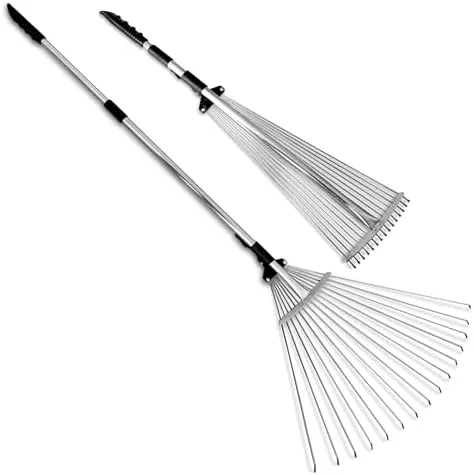
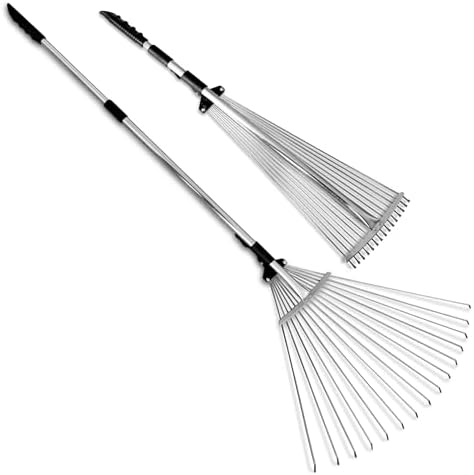
Mixed — some open lawn, some flower beds and tight spots: An adjustable fan-head rake is the practical answer. The Professional Easy Travel Folding Rake adjusts from 7.5 to 21.75 inches wide and telescopes from 37 to 68 inches. One rake, no compromises. The caveat: its aluminum shaft can bend under heavy load, so it’s better for occasional mixed-use than daily hard raking.
Mostly beds and shrubs: The TRG Groundskeeper 2 is purpose-built for this. Its rounded, stiff tines let green stems pass through without damage, it moves sticks and bark without leaving track marks, and at under 2 lbs it’s the lightest model reviewed. Replacement tines and handles are sold separately, which is genuinely useful for a tool you’re using in tight spaces where breakage is more likely.
Question 3: Do you have physical limitations or rack up a lot of raking hours?
If raking causes back or joint fatigue — or if you’re doing a large property every fall — handle length and ergonomics matter more than anything else.
The Fiskars Pro Leaf Rake is the answer here. Its 65-inch handle is meaningfully longer than the standard 48-54 inch handles most rakes ship with, which reduces how far you’re bending with every stroke. The teardrop-shaped shaft supports multiple grip positions for right and left-handed users. Double-bolted aluminum handle connections mean nothing loosens under sustained pressure. At 2.84 lbs, it’s light for a metal-connection rake.
Yes, it costs more. For someone who rakes twice a year on a small flat lawn, that premium is hard to justify. For someone with a big yard, a bad back, and a long fall season, it’s the right tool.
The Shortlist
Fiskars Pro Leaf Rake — Best for ergonomics and durability. Extra-long 65-inch handle, double-bolted connections, lightweight at 2.84 lbs. Pay the premium if you rake often or have joint concerns. Buy on Amazon
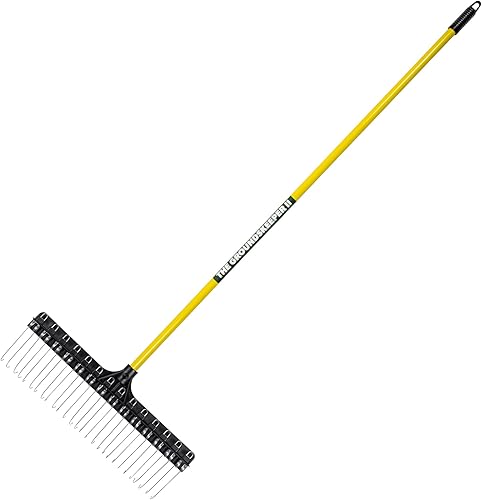
TRG The Groundskeeper 2 — Best for beds and shrubs. Under 2 lbs, rounded tines that won’t damage plants, replacement parts available. Requires some assembly. Buy on Amazon
Bully Tools Poly Leaf Rake — Best for large open lawns where you want durable coverage. 30x22-inch head, reinforced fiberglass handle, 90-degree tine angle reduces strain. Heaviest at 3.4 lbs, but built to last. Buy on Amazon
Professional Easy Travel Folding Lawn Rake — Best for mixed-use or tight storage. Adjustable head width, telescoping handle, folds flat. Not for heavy-duty daily use — the aluminum shaft has limits. Buy on Amazon
Cobalt Metal Tine Leaf Rake — Best for small embedded leaves. Metal tines grip oak leaves and stubborn debris that plastic tines miss. One caveat worth repeating directly from a reviewer: “Make sure you get a real good one because some of these tines they will start to bend and then it’s really useless after that.” Verify tine rigidity before committing. Buy on Amazon
Corona Extendable Handle Rake — For compact storage. Rust-resistant coated tines, built-in hanging ring. Max reach is only 32 inches, which limits usefulness for full-lawn raking — this is a shed-friendly tool for smaller yards. Buy on Amazon
A Few Things Worth Knowing
Tine rigidity is non-negotiable. Every reviewer who mentioned rake failures pointed to the same thing: cheap tines that bend after a few sessions. Once the tines bend, the rake is done. Spend a little more to get a rake with thick, well-secured tines — it’s the single most important quality factor.
A bow rake is a different tool. If you’re also doing lawn prep, overseeding, or spreading mulch, you need a hard/bow rake in addition to a leaf rake. They’re not interchangeable. For bow rakes specifically, look for a one-piece welded neck — the head-to-handle connection is the most common failure point.
Wide plastic tines on heavy thatch doesn’t work. Plastic tines glide over thatch and miss embedded debris. If your lawn has significant thatch buildup, metal tines are the only option that will actually clear it.
If You Read Nothing Else
- Back or joint pain, big lawn: Fiskars Pro
- Beds, shrubs, tight spaces: TRG Groundskeeper 2
- Large open lawn, speed matters: Bully Tools Poly
- Small oak-type leaves lodged in grass: Cobalt Metal Tine
- Mixed use, limited storage: Professional Folding Rake