Stop Buying a Lawn Aerator. Seriously. (And What to Get If You Won't Listen)
This article contains affiliate links — if you buy through them, we earn a small commission at no extra cost to you.
Heads up: GardenVerdict earns a commission from purchases made through links on this page. It doesn’t cost you anything extra, and it keeps the lights on.
Here’s the thing nobody tells you when you start searching “best lawn aerator to buy”: the correct answer for most homeowners is to not buy one at all.
That’s the overwhelming consensus from the r/lawncare community, where the rental vs. buy debate plays out constantly. u/keithslater put it plainly in a thread with 39 comments: “Your cheapest option will be to rent a core aerator from your hardware store. Decent ones cost a minimum $1000 to buy.” And he’s right — if you’re aerating once or twice a year on a normal suburban lot, you will never break even on a quality walk-behind machine.
But “just rent” isn’t the whole picture. If you have a tiny yard, a riding mower and a half-acre, or a rooftop garden, there are real tools worth owning. The key is matching the tool to the actual situation. Let’s work through it.
First: What Kind of Aeration Do You Actually Need?
Before anything else, spike aerators and aerator shoes are off the table. Multiple r/lawncare regulars are explicit about this. u/ricka77 (23 upvotes) says: “Spike aerators make it worse. They don’t aerate at all actually.” The mechanism is the problem — a spike displaces soil to make a hole, compacting the surrounding ground rather than relieving it. You want a core aerator that pulls actual plugs out of the ground.
That leaves three real options depending on your situation:
Answer these questions first:
- How big is your lawn? Under 1,500 sq ft → manual tools are viable (barely). 1,500–10,000 sq ft → rent. Over half an acre with a riding mower → tow-behind ownership makes sense.
- How often will you aerate? Once a year → rent every time. Twice or more per season → ownership starts penciling out.
- Do you own a riding mower or ATV? No → tow-behinds are out entirely.
Option 1: Rent a Walk-Behind Core Aerator
The right call for: Any lawn from 1,500 sq ft to about a third of an acre, aerating once or twice a year.
Home Depot and most hardware stores rent walk-behind core aerators (Bluebird, Ryan, and similar brands) for $80–$150 per half-day. For the vast majority of homeowners, this is the answer — period.
u/CPOx (8 upvotes) makes the cost-splitting case well: “To get a better value, talk to some neighbors and see if they want to chip in some money and have a neighborhood aeration day. My lawn is .3 acres and I did a triple pass of aeration and still had several hours left on my half day rental.”
Multiple passes at different angles is the correct technique anyway — it dramatically increases the percentage of soil disturbed — so having extra time on a rental isn’t wasted.
That said, these machines are not fun. u/Konorlc (7 upvotes) is honest about it: “I rented one last year for around $80. It was a bitch. It is very heavy and a pain in the ass to get in and out of the truck. Also very difficult to control. Shit kicked my ass.”
Pros:
- Most effective aeration available — commercial-grade plugs across the full lawn
- No storage, maintenance, or depreciation
- Home Depot rents by the half-day; 0.3 acres with multiple passes fits easily
- Split cost with neighbors to reduce it further
Cons:
- Requires a truck or trailer to transport — adds cost and hassle
- Physically demanding to operate
- Logistical overhead: scheduling, loading, returning
One additional tip from the r/lawncare community: Home Depot occasionally sells retired rental equipment. u/Snowmobiler624 flagged this: “A lot of people don’t know they sell their rental equipment when they get new stuff. My dad and I split one a few years back and I think it was $250 or $300 and was in pretty good shape.” Worth checking before buying new. Buy on Amazon
Option 2: Yard Butler ID-6C Manual Core Aerator — For Small Yards

The right call for: Lawns under 1,500 sq ft, townhouse side yards, or spot-treating problem areas.
$30–$50 · Buy on Amazon
The Yard Butler is a legitimate core aerator — two hollow tines, 3.5-inch plug depth, 37-inch shaft so you can stand upright while working. The lifetime guarantee is rare at this price. It works in clay if you pre-water the lawn thoroughly (or aerate right after rain).
The caveat is brutal math. u/Vito_The_Magnificent ran the numbers in a thread specifically about manual aerators, and it’s sobering: “For a 1,600 sq foot lawn, to disrupt 3% of the soil surface (effective minimum) with a Yard Butler, you need to step on it about 17,000 times. It removes 0.4 sq inches per step. At 5 seconds per step, that’s about 25 hours of work to aerate your lawn to a minimum standard.”
u/Brilliant_Doctor_846 bought one for an 8,500 sq ft lawn and simply wrote: “I bought a yard butler for my 8500 sqft…wish me luck.” The sub did not respond encouragingly.
The YouTube reviewer covering manual aerators echoes this: for compact clay, plan short sessions and pre-soak the soil. The tool works — it’s the labor scaling that’s the problem.
Pros:
- Real core aeration — 3.5-inch plugs, not spikes
- 37-inch shaft, stand upright while working
- Solid steel with powder coat finish, resists rust
- Lifetime guarantee
- Works in clay soil with pre-watering
Cons:
- 25+ hours to hit minimum effective coverage on a 1,600 sq ft lawn (per community math)
- Tines are dull out of the box — consider sharpening before first use
- Two holes per step; plugs occasionally get stuck and need manual clearing
- Completely impractical for anything over 2,000 sq ft
Option 3: Corona MAX YardBREATHER — The Auto-Eject Alternative
The right call for: Small lawns with loose, well-moistened soil.
$40–$60 · Buy on Amazon
The Corona’s main selling point over the Yard Butler is its auto-eject mechanism — theoretically, plugs pop out automatically rather than requiring a stick to clear them. Available at Lowe’s, which makes it easy to test and return.
The community is split. u/wdyszkie had good luck after rain: “I got the Corona one because I saw it at Lowes and figured I’d return it if it clogged. I’ve done about 200 sqft already and it works like a dream. Had storms the last 2 days and I think the saturation of the ground helps.”
u/njric71 had the opposite experience: “I have the Corona brand 2 prong one. I highly DON’T recommend it. The tubes clog up and are a pain to clear. If I aerate again I’m going to use a spading fork.”
The pattern here is clear: moist, loose soil → fine. Clay or dry conditions → the auto-eject clogs constantly and the tool becomes more frustrating than the Yard Butler.
Pros:
- Auto-eject mechanism reduces manual plug clearing (in ideal conditions)
- Widely available at Lowe’s — easy to test and return if it doesn’t work
- Similar price to Yard Butler
Cons:
- Tubes clog frequently in clay-heavy soil, negating the auto-eject advantage
- Same severe time and labor limitations as all manual core aerators
- Mixed community results depending on soil type and moisture
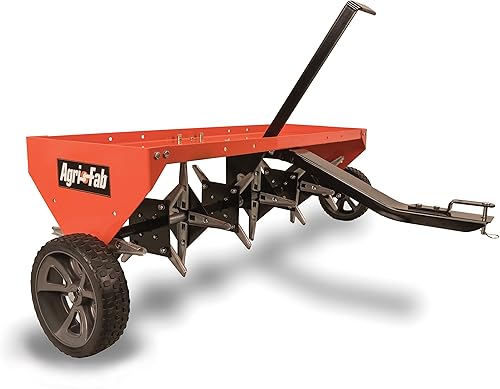
Option 4: Agri-Fab 48” Tow-Behind Plug Aerator — For Large Properties
The right call for: Half-acre+ lawns with a riding mower, aerating at least twice a year.
$250–$400 · Buy on Amazon
If you have a riding mower and a large lawn, the math flips — a tow-behind aerator pays for itself in two to three seasons versus annual rentals. The Agri-Fab 48” is the community’s preferred option in this category.
The 48-inch coverage means dramatically fewer passes than a walk-behind. The 32 galvanized knives resist rust and pull plugs up to 3 inches deep. A cantilever lever raises and lowers the knives in one motion for crossing pavement — a small feature that matters when you’re doing a full property. Sealed bearings mean minimal upkeep beyond annual greasing. And the knives are bolted rather than riveted, so they can be sharpened or replaced individually.
Agri-Fab builds this in Illinois with a 3-year consumer warranty — longer than most competitors in the category.
The YouTube reviewer covering this category put it simply: “For coverage, depth, build quality, and long-term value, the Agri-Fab stands at the top of this lineup.”
User Greg echoes the value case: “I read all the reviews and did my homework before purchasing. This seemed like a good choice. I have a large yard. This thing works really well. Will pay for itself after using it twice, so it makes sense.”
Pros:
- 48-inch coverage — dramatically fewer passes needed
- 32 galvanized knives, up to 3-inch plug depth
- Cantilever lever for one-motion knife raise/lower
- Sealed bearings, minimal maintenance
- Bolted knives — replaceable and sharpenable
- 3-year consumer warranty, made in Illinois
Cons:
- Requires a riding mower, zero-turn, or ATV — useless without one
- Price has increased with inflation
- Assembly requires patience
Option 5: Brinley 48” Universal Hitch Aerator — The Budget Tow-Behind
The right call for: Large lawns where the Agri-Fab is out of budget, or particularly hard summer-baked soil.
$200–$350 · Buy on Amazon
The Brinley covers the same 48-inch swath as the Agri-Fab with four independent tine sections that follow uneven terrain without scalping turns — useful if your property isn’t flat. The steel weight tray holds up to 200 lbs, which helps drive plugs into hard, dry soil that would resist a lighter machine. Flat-free tires and a single transport lever round it out.
The meaningful trade-off versus the Agri-Fab: the Brinley uses spike-style “spoons” rather than hollow-tube plug extraction. It’s less aggressive than true plug aerators — closer to aggressive spiking than full core aeration. For lawns with severe compaction, the Agri-Fab’s hollow knives are worth the extra cost.
Pros:
- 48-inch coverage, works with lawn tractors, zero-turns, and light ATVs
- 200-lb weight tray capacity for hard soil
- Four independent tine sections follow uneven terrain
- Flat-free tires, no puncture concerns
Cons:
- Spike-style spoons rather than hollow-tube plug extraction — less effective for deep compaction
- Same riding-mower dependency as the Agri-Fab
Option 6: Greenworks 40V Cordless Dethatcher — For Rooftop and Shallow-Soil Setups

The right call for: Rooftop gardens, elevated balcony turf, or homeowners primarily fighting thatch rather than compaction.
$150–$250 · Buy on Amazon
The Greenworks isn’t a core aerator — be clear on that before buying it. It creates surface slits and lifts thatch rather than pulling plugs. That makes it wrong for standard in-ground lawns with compaction problems, but exactly right for rooftop or balcony setups where the soil layer is too shallow for deep plug extraction.
Swappable cartridges let you run spring tines for dethatching or a scarifier reel for surface scoring. Shares batteries with the Greenworks trimmer and blower ecosystem, which matters if you’re already in that system.
The reviewer in the YouTube comparison video describes it well: “Does exactly as intended. Wish I would have taken before and after photos, but I was able to remove several lawn and garden bags full of dead undergrowth. Highly recommend and easy to assemble.”
Pros:
- Cordless — no gas fumes, no extension cords
- Swappable cartridges for dethatching or scarifying
- Lightweight, 14-inch path — manageable in tight or elevated spaces
- Five depth settings, adjustable on the fly
- Shares batteries with Greenworks ecosystem
Cons:
- Not a true core aerator — does not pull plugs
- Wrong tool for standard in-ground lawn compaction
Quick Reference
| Situation | Best Tool |
|---|---|
| Any normal lawn, 1,500–10,000 sq ft | Rent a walk-behind ($80–$150/half-day) |
| Tiny yard under 1,500 sq ft, no truck access | Yard Butler ID-6C (~$40) |
| Clay soil, small lawn, post-rain conditions | Corona MAX YardBREATHER (~$50) |
| Half-acre+, own a riding mower | Agri-Fab 48” Tow-Behind ($250–$400) |
| Large lawn, tight budget, uneven terrain | Brinley 48” Hitch Aerator ($200–$350) |
| Rooftop turf or thatch (not compaction) | Greenworks 40V Dethatcher ($150–$250) |
Before You Do Anything
Pre-water. This cannot be overstated — dry clay will clog tube aerators, make manual tools nearly impossible to push, and reduce plug quality from rental machines. Water thoroughly the day before, or time aeration to follow a soaking rain.
And if you’re considering hiring it out, the community has a caveat: several r/lawncare users report lawn services doing rushed or incomplete passes, skipping corners, or missing entire sections. If you’re paying someone, watch them work or ask specifically about multiple-direction passes on problem areas.
For most homeowners, the answer really is simple: call your neighbor, split a half-day rental, and coordinate with someone who has a truck.