Cordless Tillers: What Reddit Gardeners Actually Think (vs. What YouTube Tells You)
This guide contains affiliate links. If you buy something through them, we earn a small commission at no extra cost to you — it’s how we keep the research going.
Heads up: links in this article may earn a small commission at no cost to you. Research is based on Reddit community feedback and independent analysis — not manufacturer claims.
Here’s the thing nobody tells you before you drop $200 on a cordless tiller: it probably won’t do what you think it will.
Browse YouTube for “best cordless tiller” and you’ll find polished ranking videos with confident voiceovers claiming brushless motors “tear through compacted soil with ease.” Scroll Reddit for five minutes and you get a very different picture. u/EddieRyanDC on r/vegetablegardening put it plainly:
“A machine to do that would have to be as weighty and substantial as the ground itself. Because it will be a contest between the machine and the ground, and without massive weight, the ground will win and the roto-tiller will just scoot across the top without breaking up anything.”
That’s the myth worth busting first. Cordless tillers are not small gas tillers. They’re amendment mixers, raised-bed maintenance tools, and topsoil looseners. If you have unbroken clay or compacted lawn you’re converting to garden space, a cordless model will frustrate you. Rent a rear-tine gas tiller for that job — or hire someone with a tractor.
Once you accept that scope, cordless tillers become genuinely useful tools. The question is which one fits your specific situation.
Who Should Even Buy a Cordless Tiller?
Before reviewing any product, here’s the honest decision tree:
You’re a good candidate if:
- Your garden is under ~500 sq ft of already-worked soil
- You till 2–4 times per year (spring prep, fall amendment mixing)
- You have raised beds that need amendment worked in each season
- You have mobility or strength limitations that make a gas tiller impractical
- You already own a matching battery platform (40V Ryobi, etc.)
You should rent or go gas if:
- You’re breaking new ground for the first time
- Your soil is compacted, clay-heavy, or hasn’t been tilled in years
- Your garden is larger than 500–600 sq ft
- You till frequently and need consistent depth beyond 8 inches
u/trebuchetguy, who gardens 650 linear feet and uses a 5hp Briggs & Stratton gas tiller for his main plot, still uses a cordless Ryobi attachment for raised beds — and that’s exactly the right mental model: cordless for the supplemental stuff, real power for the heavy lifting.
The Products: Honest Assessments
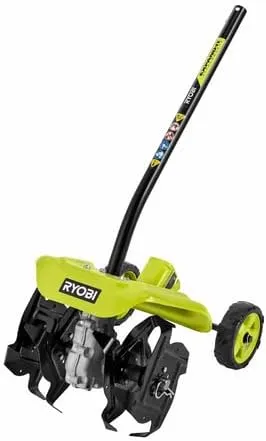
Ryobi 40V Battery Trimmer Attachment Tiller

Price: ~$100–$200 (attachment only) Best for: Ryobi 40V ecosystem owners with raised beds
This isn’t a standalone tiller — it’s a head attachment for Ryobi’s 40V trimmer system. Which is either a dealbreaker or a huge advantage depending on what’s already in your garage.
u/trebuchetguy described his experience directly:
“It is great for my raised beds to till up the top few inches and to mix in amendments. Super light and you have to get positioned over it to put some weight on it, but I like it as an adjunct to my standard 5hp Briggs and Stratton tiller for my big area.”
That quote captures both the strength and weakness. It mixes amendments beautifully. It won’t go deep without leaning your body weight over it, which creates awkward ergonomics. But if you already own the Ryobi 40V battery and charger, the incremental cost is low and the raised-bed use case is well-matched.
Pros:
- Extremely lightweight — minimal fatigue in raised beds
- No extra battery/charger needed if you’re in the Ryobi 40V ecosystem
- Excellent for amendment mixing in top 3–4 inches
Cons:
- Requires compatible Ryobi trimmer system — not standalone
- Awkward ergonomics when you need to add downward pressure
- Not appropriate for any serious ground-breaking
Earthwise TC70040 40V Cordless Tiller
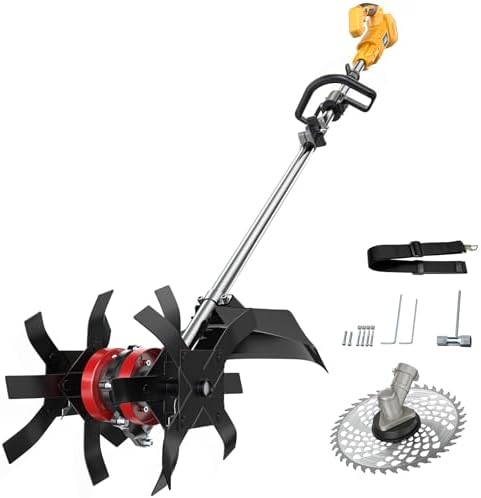
Price: ~$150–$200 Best for: Small-to-medium garden owners who want cordless with real torque
This is the most talked-about cordless tiller in the Reddit threads — and the feedback is genuinely mixed in an instructive way. User u/confused_boner on r/lawncare bought it for their mother’s garden and discovered a torque problem they didn’t expect:
“Can’t let her use it cause it’s so powerful it just pulls her along, kicks my ass every time I use it.”
That’s actually a useful data point. The TC70040 has more aggressive pull than you’d expect from a cordless unit. For a physically capable gardener working pre-tilled soil, that torque is an asset. For someone with limited strength or working in a cramped raised bed, it’s a hazard.
Separately, u/people_skills noted that an Earthwise electric tiller (corded, same brand) was fine for ~500 sq ft but struggled with compacted soil — consistent with the brand’s positioning as a light-to-medium duty tool.
Pros:
- Genuinely surprising torque for a cordless unit
- Cordless freedom without gas fumes or cord management
- Established brand with parts availability
Cons:
- Aggressive pull makes it unsuitable for users with limited strength
- Battery runtime limits larger plots
- Struggles with genuinely compacted or clay-heavy soil
Earthwise TC720 20V Cordless Tiller

Price: ~$80–$120 Best for: Container gardeners, small raised beds, or anyone prioritizing lightweight handling
At 5.5 lbs with a 90-minute charge time, the TC720 is the most accessible entry point in this category. The 7.5-inch tilling width and 6-inch depth tell you everything you need to know: this is a narrow-path maintenance tool for loose topsoil only.
The YouTube affiliate video covering this model notes its narrow width means extra passes on any area larger than a few square feet — and at 20V, you’ll notice the power drop compared to 40V units the moment you hit anything with real resistance.
For the specific use case it’s designed for — a few small raised beds, a container garden, border maintenance — the light weight and quick charge make it genuinely practical. For anything else, the underpowering becomes obvious fast.
Pros:
- Lightest option reviewed — minimal arm fatigue
- Quick 90-minute charge
- Low cost of entry
Cons:
- 7.5-inch width requires many passes on any meaningful area
- 6-inch max depth — not suitable for deep soil prep
- 20V insufficient for compacted or clay soils
Tasar TU5000 Cordless Electric Tiller

Price: ~$150–$250 Best for: Medium-to-large garden owners who want maximum cordless tilling width
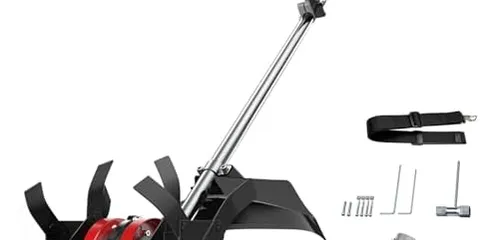
On paper, the Tasar TU5000 has the most impressive cordless specs in this review: 14-inch tilling width (widest here), 9-inch depth, brushless motor, dual 5000mAh batteries, and four-position gear adjustment.
The honest caveat: the sourcing on this product is a YouTube affiliate ranking video with no verifiable real-world user testing. The claims have not been stress-tested by Reddit’s skeptical gardening community, so treat the specs as manufacturer-reported rather than community-verified.
What the specs suggest: if you have an established medium garden in already-worked soil and want to cover ground quickly with a cordless unit, the 14-inch path and brushless motor are genuinely better than the alternatives. The 40-minute runtime on a 2.5–3 hour recharge is a legitimate constraint for larger sessions.
Pros:
- 14-inch tilling width — widest cordless option reviewed
- 9-inch depth — deeper than most cordless competitors
- Brushless motor for durability
- Dual batteries for extended runtime
Cons:
- 40 minutes of runtime is limiting for larger gardens
- 2.5–3 hour recharge time
- No independent Reddit/community verification of performance claims
Maxlander SF8G601 40V Cordless Tiller
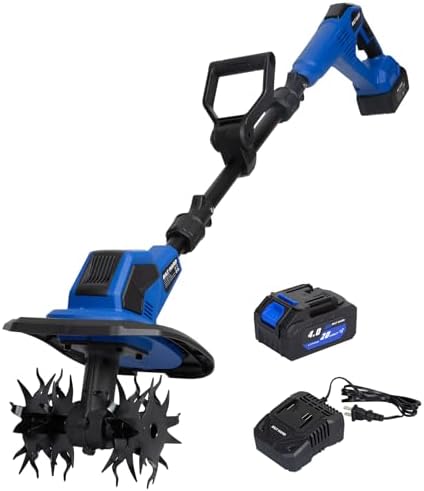
Price: ~$200–$300 Best for: Gardeners who want the most capable cordless specs without going gas
The Maxlander is the premium end of the cordless category: 40V brushless motor, 12-inch tilling width, 8-inch depth, two 4Ah batteries, folding handle for storage. It’s the option you choose when you want to push the ceiling of what cordless can do.
Same caveat as the Tasar: the primary source is a YouTube affiliate ranking video. The specs are plausible and the design reflects genuine engineering choices (40V is materially better than 20V, brushless motors do last longer), but there’s no community verification.
At $200–$300, you’re approaching the price range where a corded tiller with a good extension cord starts making more economic sense for consistent performance. If cordless freedom is non-negotiable and budget extends here, the Maxlander is the logical ceiling.
Pros:
- 40V among highest voltage in cordless category
- 12-inch width covers more ground per pass
- Brushless motor for longevity
- Dual 4Ah batteries
- Folding handle for storage
Cons:
- Heavier than smaller cordless competitors
- No independent community verification of real-world performance
- Price approaches corded tiller territory
Quick Comparison Table
| Model | Voltage | Width | Depth | Weight | Best For |
|---|---|---|---|---|---|
| Ryobi Attachment | 40V | ~6–8” | ~3–4” | Very light | Ryobi ecosystem, raised beds |
| Earthwise TC720 | 20V | 7.5” | 6” | 5.5 lbs | Container/small raised beds |
| Earthwise TC70040 | 40V | 11” | ~6–8” | Moderate | Small-medium pre-worked plots |
| Tasar TU5000 | 40V | 14” | 9” | Moderate | Medium-large beds, max cordless width |
| Maxlander SF8G601 | 40V | 12” | 8” | Heavier | Premium cordless, larger gardens |
One Thing Reddit Agrees On
Across five threads and dozens of comments, experienced gardeners consistently land on the same recommendation: for first-time ground-breaking, rent a rear-tine gas tiller. The reasoning is unanimous.
u/manyamile on r/vegetablegardening:
“If you’re committed to tilling, u/trebuchetguy is on point about the weight and power. You’re better off renting a high quality rear tine tiller for an afternoon and never using it again.”
u/zooloo10 added the math that often gets ignored:
“If you just are looking to till like 2 or 3 4x8 spots a year it may be worth it [getting a broadfork]. Depending on how much land you want to till, you could just get a broad fork, probably save yourself a few hundred bucks.”
The broad fork recommendation shows up repeatedly and deserves mention: for loose raised-bed soil, a quality broad fork does the deep aeration work that cordless tillers can’t, without battery limitations, motor wear, or tine replacement.
The Bottom Line
If you read nothing else: buy a cordless tiller only if you have under 500 sq ft of already-worked, loose soil, and you’re primarily mixing amendments or doing seasonal maintenance.
For that use case, the right pick depends on what you already own:
- Already in the Ryobi 40V ecosystem? The trimmer attachment tiller is the most cost-effective add-on.
- Want a standalone unit with proven community feedback? The Earthwise TC70040 40V has the most real-world user data — just know it has aggressive pull.
- Want maximum cordless specs and budget extends to $200–$300? The Maxlander or Tasar give you the widest path and deepest reach, though without Reddit community verification.
- Tight budget, tiny beds? The Earthwise TC720 20V at ~$100 does the job for genuinely light maintenance work.
For anything heavier than that — new ground, clay, fallow plots, gardens over 600 sq ft — rent the gas tiller, do it once right, and use the cordless tool for maintenance afterward. That’s what the experienced gardeners are doing.