Corded or Cordless Garden Tiller? Answer These 3 Questions First.
Heads up: Some links below are affiliate links. If you buy through them, we earn a small commission at no cost to you.
Most tiller buying guides tell you their “best overall” pick and call it a day. The problem is that a tiller that’s perfect for a 10x10 raised bed garden is genuinely wrong for a 40x20 in-ground vegetable plot — and vice versa. The answer here isn’t one product. It’s a decision.
Work through these three questions and you’ll land in the right place.
Question 1: Do you have a reliable outdoor outlet within cord reach of your garden?
If yes — and you can manage an extension cord without it becoming a tripping hazard or a nuisance — start with corded. Corded tillers deliver continuous, consistent power with no runtime ceiling. You can till for three hours on a hot Saturday and the motor doesn’t care.
If no — your garden is far from the house, you’re working in a detached side yard, or running an extension cord across your lawn sounds like a project in itself — go cordless. Accept the trade-offs going in: narrower tilling width and a 30–45 minute battery window per charge.
Question 2: How big is the area you’re tilling?
This is where width matters more than almost anything else. An 18-inch tiller covers the same ground in roughly half the passes of a 9-inch model. On a 500 sq ft bed, that difference is the gap between 20 minutes and 40 minutes of work.
- Small (under 100 sq ft, raised beds, flower borders): Narrow cordless or compact corded models are fine. You’re not losing meaningful time.
- Medium (100–400 sq ft): Mid-size corded (12–16 inch) or a 40V cordless if outlet access is poor.
- Large (400+ sq ft): You want the widest corded tiller you can find. Cordless won’t cut it — not in runtime, not in width.
Question 3: What’s your soil like?
Hard clay or compacted soil eats weaker motors alive. If your ground hasn’t been worked in years — or you’re breaking new ground — you need higher amperage (10A+) and higher RPM. If you’re just refreshing beds that were tilled last season, almost any model will do.
The Recommendations
If you need corded power for medium to large beds: Lawnmaster 18-inch

The Lawnmaster is the one to beat in the corded category. The 18-inch width is the widest of any electric model reviewed here, and the detachable tine system is genuinely useful — drop from 6 tines (18-inch wide pass) to 4 tines (12.6-inch) when you’re working between established plants or in tighter rows. It spins at 380–390 RPM with six rust-resistant blades and handles clay-heavy soil well.
The mechanical overload protection — an automatic shutoff when the tines hit rocks or hard objects — isn’t just a marketing feature. It protects the motor from a stall burnout, which is a real failure mode on cheaper models.
Tilling width: 18 in (or 12.6 in with tines removed) | Depth: 9 in | Cord: Yes
If you need the most raw corded power: Sun Joe 16-inch
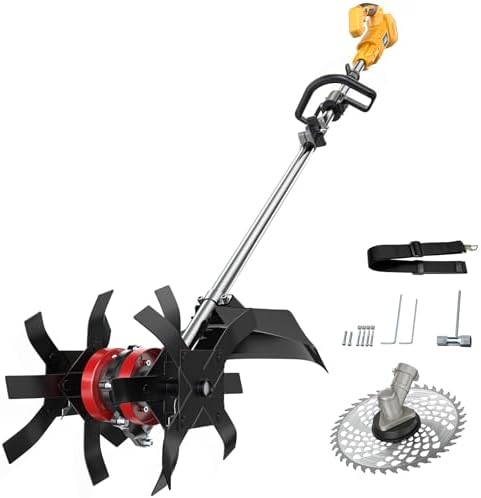
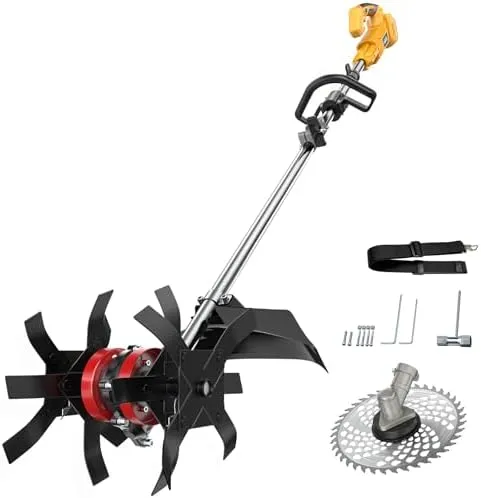
The Sun Joe runs a 13.5-amp motor — the strongest corded option in this review — spinning six angled steel tines at 370 RPM. It’s slightly narrower than the Lawnmaster (16 vs. 18 inches), but that motor is legitimately capable on compacted ground. Reviewers consistently highlight the tilling efficiency and build quality of the steel tines.
It’s heavier than smaller corded options, but most people who’ve used it report the power-to-weight trade-off is worth it. Foldable handle and adjustable wheel system make storage and transport manageable.
Tilling width: 16 in | Depth: 8 in | Amps: 13.5A | Cord: Yes
If you’re doing raised beds or small gardens corded: Earthwise 7.5-inch
At 8.8 lbs, the Earthwise is almost shockingly light — easier to carry than a bag of potting soil. The 7.5-inch width is a limitation in open beds but a genuine advantage in narrow flower borders and between raised bed rows where a 16-inch tiller physically can’t fit. Single-lever switch, soft grip handle, plug-in-and-go simplicity. Not for compacted soil or anything bigger than a modest bed, but it’s excellent at what it is.
Tilling width: 7.5 in | Depth: 6 in | Weight: 8.8 lbs | Cord: Yes
If you can’t run a cord: Greenworks 40V Cordless

The Greenworks 40V is the right cordless pick for anyone with a small to medium garden — roughly up to 300 sq ft per charge session. The 4.0 Ah battery gives about 45 minutes of runtime, recharges in 2 hours, and the tiller itself weighs only 21 lbs. Adjustable tilling width from 8.25 to 10 inches handles different row spacings.
The real value-add: if you already own Greenworks 40V outdoor tools (mower, blower, trimmer), this tiller runs on the same battery. That’s a meaningful ecosystem play — no new charger, no extra investment.
Battery life will feel short on larger gardens. A few reviewers mention 45 minutes goes faster than expected. If that’s your situation, buy a second battery upfront rather than getting surprised mid-bed.
Tilling width: 8.25–10 in | Depth: not specified | Battery: 40V 4.0 Ah | Runtime: ~45 min | Weight: ~21 lbs
If you need cordless for the lightest possible tool: Alloyman 20V
The Alloyman is the only model here that ships with two batteries, and at just over 14 lbs it’s the lightest option reviewed. The dual-battery setup effectively doubles your working time without a long recharge wait — swap batteries and keep going.
The trade-offs are real: 20V doesn’t have the power of 40V, so you’re limited to 9 inches wide and 6.6 inches deep. Each battery runs around 30 minutes in real-world use (not the spec figure). This is a raised-bed and small-garden tool. Push it beyond that and you’ll be frustrated.
The dual-safety switch (both a safety button and trigger must be pressed simultaneously) is a smart design feature for a lightweight tool that’s easy to pick up and accidentally actuate.
Tilling width: 9 in | Depth: 6.6 in | Battery: 20V (×2 included) | Runtime: ~30 min/battery | Weight: ~14 lbs
The mid-size corded dark horse: MZK 12-inch
The MZK deserves a mention for its unusually high RPM — 430 RPM via a pure copper core motor, the fastest of any model here. Sixteen steel blades across four tines is also an unusually high blade count that reviewers say translates to thorough soil breakup. At 12 inches wide and 8 inches deep, it splits the difference between the compact Earthwise and the full-size Sun Joe.
It’s a less established brand with fewer long-term durability reports, but the short-term performance reviews are consistently positive. Worth considering if you want mid-size coverage at potentially the lowest price point in the corded lineup.
Tilling width: 12 in | Depth: 8 in | RPM: 430 | Cord: Yes
Comparison at a Glance
| Model | Width | Depth | Power | Best For |
|---|---|---|---|---|
| Lawnmaster 18-inch | 18 in (adj. to 12.6) | 9 in | Corded | Large beds, clay soil, versatility |
| Sun Joe 16-inch | 16 in | 8 in | 13.5A corded | Max power, medium-large beds |
| MZK 12-inch | 12 in | 8 in | Corded, 430 RPM | Mid-size beds, budget corded |
| Earthwise 7.5-inch | 7.5 in | 6 in | 2.5A corded | Tight spaces, raised beds |
| Greenworks 40V | 8.25–10 in | — | 40V cordless | No-cord medium gardens |
| Alloyman 20V | 9 in | 6.6 in | 20V cordless ×2 | Small beds, lightest option |
One thing to be realistic about
No electric tiller — corded or cordless — matches a gas tiller on heavily compacted, rocky ground in a single pass. If you’re breaking sod for the first time or dealing with serious rock content, you may need multiple passes regardless of which model you choose. That’s not a failure; it’s just physics. Electric tillers win on maintenance, noise, emissions, and cost. They trade raw single-pass power.
If you read nothing else: cord access and garden size are the two decisions that actually determine which tiller is right for you. Everything else — RPM, brand, blade count — is secondary to getting those two calls right.