The Battery-Powered Broadcast Spreader Is a Trap. Here's What to Buy Instead.
This article contains affiliate links — if you buy through them, we earn a small commission at no extra cost to you.
GardenVerdict earns a small commission on purchases made through links in this article — at no extra cost to you.
Here’s the thing about battery-powered broadcast spreaders: a lawn care professional with 15 years of experience basically told us to avoid them entirely.
We went looking for the best battery-powered walk-behind broadcast spreader on the market. What we found instead was a clear professional consensus: battery-powered handheld spreaders leave visible stripes and clumping because product drops straight down rather than spreads evenly, and the mechanics break in ways that can’t easily be repaired in the field. For a true walk-behind broadcast spreader with a motor — the kind that does the spinning for you — the category barely exists at consumer price points, and the options that do exist inherit all those same problems at larger scale.
The market that is well-developed, highly reviewed, and built to last a lifetime? Manual push broadcast spreaders. And if you’re mowing a lawn, you’re already pushing something. The good ones require almost no effort to operate — the hopper gate and spinner are passive, triggered by a single hand lever.
So this guide pivots: here’s what to actually buy, and why the battery gimmick isn’t worth it.
Answer These Three Questions First
1. How big is your lawn? Under 1,500 sq ft per section → a handheld crank spreader ($25–$50) beats any push spreader for consistency. Push spreaders are overkill. Over 5,000 sq ft → you need a quality push spreader with pneumatic tires and a mechanically stable gate. The Scotts EdgeGuard starts to show its limits here.
2. Do you have curbs, driveways, or flower beds to protect? If yes, you need a true trim guard — one that actually reduces the drop rate on the protected side, not just a plastic flap that blocks but doesn’t close the gate. This matters more than most buyers realize.
3. Will you assemble it, or do you want it ready out of the box? EarthWay requires ~1 hour of assembly. Echo ships fully assembled. If assembly sounds like a Saturday-morning chore you’ll procrastinate, start with the Echo.
The Three Contenders
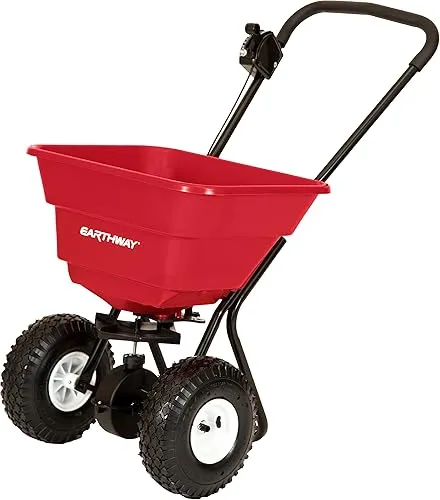
Best Overall: EarthWay 2600 — $191
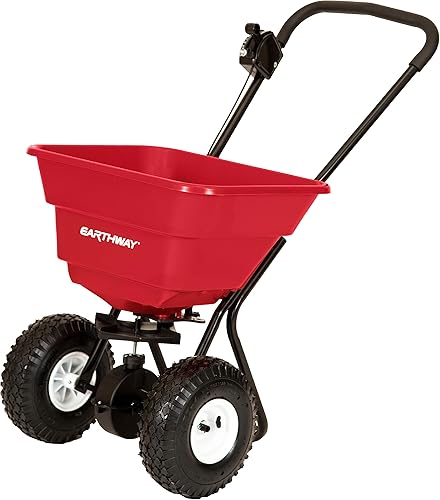
Made in Bristol, Indiana. The reviewer who tested this put it simply: “This will last you the rest of your life.”
What makes the EarthWay 2600 stand out isn’t a single feature — it’s the mechanical philosophy. Where Scotts uses a spring-and-cable linkage to control drop rate (a design that degrades as the spring stretches and the cable kinks), EarthWay uses a simple latch mechanism with no springs to wear out. The drop rate stays consistent season after season without recalibration.
The trim guard is also genuinely functional: it cuts the drop rate on the closed side rather than just blocking spray. If you have beds or a driveway running alongside your lawn, this is the spreader that protects them accurately. The round hopper design gives you better line of sight on your spread pattern, and the air-filled pneumatic tires handle bumpy terrain or thick grass (St. Augustine owners, take note) without fighting you.
The downsides are real: assembly takes about an hour, the handle runs short for anyone over 5’11”, and $191 is a genuine commitment. But for a medium-to-large lawn (5,000+ sq ft), you’re buying it once and you’re done.
Best Ready-to-Use: Echo RB60 — $149.99

The Echo RB60 ships fully assembled, which sounds minor until you remember the EarthWay’s hour-long build. Pull it out, fill it, go.
The more important engineering distinction: the RB60 uses a positive stop (static setting) for drop rate. On a Scotts spreader, the setting shifts slightly every time you open and close the gate, because the gate mechanism is coupled to the setting. On the Echo, the drop rate setting is fixed independently — the gate opens and closes around a static calibration point. This is why a 15-year lawn pro called it “more accurate because the setting is static — it doesn’t move.”
It also mirrors Scotts spreader settings directly, so any fertilizer bag you pick up at the garden center will have a compatible setting printed on the label. Pneumatic tires are included.
The catch: it’s only available through Echo dealers, not big-box stores. And the price has climbed roughly 50% in two years (from $99.99 to $149.99), which stings. But for accuracy, convenience, and longevity, it sits comfortably between the Scotts and the EarthWay.
Best for Small Lawns / Big-Box Convenience: Scotts EdgeGuard DLX — $89.99
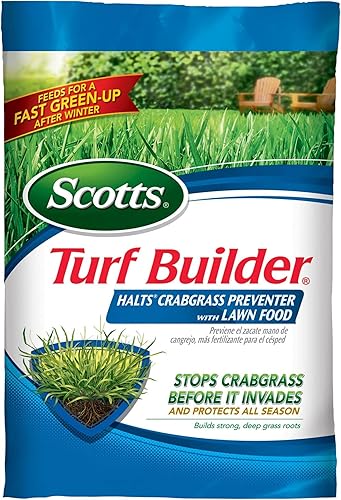
If you’ve ever bought fertilizer, you’ve seen the Scotts settings chart on the bag. That ubiquity is the EdgeGuard DLX’s strongest argument: you never have to look up a conversion table.
For lawns broken into sections under 2,000 sq ft, it gets the job done. It’s widely available at Home Depot and Lowe’s, it’s the cheapest of the three, and the settings are on every major fertilizer bag sold in the US.
But the spring-and-cable gate mechanism is a real long-term limitation. As one reviewer noted, “if this spring gets stretched out or this cable kinks, the fertilizer won’t fall through fast enough” — and that inconsistency compounds over large, continuous lawn runs. The plastic wheels don’t help on rough terrain.
Use it for a small or medium lawn. Don’t rely on it for large continuous coverage where precision compounds over distance.
Quick Comparison
| EarthWay 2600 | Echo RB60 | Scotts EdgeGuard DLX | |
|---|---|---|---|
| Price | $191 | $149.99 | $89.99 |
| Gate Mechanism | Latch (no springs) | Static positive stop | Spring + cable |
| Pneumatic Tires | Yes | Yes | No |
| True Trim Guard | Yes | Not specified | Partial blocker |
| Assembly Required | ~1 hour | No | Minimal |
| Where to Buy | Amazon/online | Echo dealers | Big-box stores |
| Best For | Large lawns, max precision | Ready-to-use accuracy | Small lawns, casual use |
What to Skip
Battery-powered handheld spreaders — the pro consensus is clear: product drops down rather than spreads evenly, visible striping results, and the mechanical components break without easy field repair. Save your money.
Scotts EdgeGuard Mini (~$47) — hollow plastic wheels, poor balance, inconsistent spread. A $25 hand crank spreader actually outperforms it on small lawns.
Any spring/cable-gated spreader for large lawns — the inconsistency is minor on a 1,500 sq ft run and significant on a 10,000 sq ft one.
The Bottom Line
If you read nothing else: the Echo RB60 is the best spreader for most people. It arrives assembled, runs accurately, matches Scotts settings, and lasts as long as the EarthWay at a $40 savings.
If you have a large lawn and want the best accuracy money can buy, spend the extra $40 and get the EarthWay 2600. The made-in-USA mechanical simplicity and genuine trim guard are worth it for a tool you’ll use for the next 20 years.
And if someone tries to sell you a battery-powered broadcast spreader? Ask them how it handles product distribution consistency on uneven terrain. The answer tells you everything.