Before You Buy a Backyard Greenhouse Kit, Answer These 3 Questions
Some links below are affiliate links. If you buy through them, we earn a small commission at no extra cost to you.
The most common greenhouse mistake isn’t buying the wrong kit — it’s buying a kit before answering the right questions. People buy cheap, expect winter tomatoes, get flipped structures and $400 heating bills, and swear off greenhouses forever. Or they go premium and discover the $10,000 kit sat in a box for two months because foundation prep alone took a contractor three weeks.
The “best” greenhouse is entirely about your situation. Here’s how to figure out which one that is.
Answer These 3 Questions First
1. What do you actually want to grow — and when?
This is the fork in the road that determines everything else.
- Season extension (spring/fall): You want to start seeds earlier and harvest later. You’re not heating the space in winter. A single-layer cover or cheap twin-wall polycarbonate is fine.
- Three-season or mild-winter growing: You want to grow cold-hardy crops (greens, brassicas) through winter without heavy heating. You need 6mm twin-wall polycarbonate minimum — single-layer won’t hold enough heat to matter.
- Heated year-round growing: You want tomatoes in January. You need triple-wall polycarbonate, a real heating system, and a willingness to pay for it. A poorly insulated greenhouse on a heater is just an expensive way to heat the outdoors.
2. What’s your climate actually like?
Snow and wind are structural questions, not comfort questions. A greenhouse that gets flipped or collapses under snow load isn’t a gardening setback — it’s a safety incident. Check: Does your area get sustained winds over 45 mph? More than occasional heavy snow? If yes, you need published load ratings. “Should be fine” is not a load rating.
3. What’s your real budget?
Kit prices are misleading. Add $500–$3,000 for a foundation (required for any rigid-frame structure in a wind-prone area), plus extra vents ($50–$200 each), exhaust fans, and shelving. A “$900 greenhouse” frequently runs $1,500–$2,200 by the time it’s actually standing and functional. Budget accordingly before you fall in love with a kit price.
Based on Your Answers, Here’s What to Buy
If you want season extension only and your climate is mild: start with the Harbor Freight

The Harbor Freight 10x12 Buy on Amazon is legitimately the best value in rigid-frame kits at around $750–$900 — roughly $7.50/sq ft — if you know what you’re buying.
What’s good: it comes with four roof vents, which is double what most comparably priced kits include. The frame assembles first, then panels attach from the outside, so replacing a blown panel doesn’t require any disassembly. The wide double door lets you wheel in a barrow.
What’s not good: there’s no published wind load rating, no snow load rating, and the ~4mm twin-wall polycarbonate is barely better than a tent in cold weather. There are documented cases of these being lifted and flipped in wind. “I’ve seen videos on YouTube where people bought this greenhouse and it was picked up and flipped over by the wind,” noted one reviewer, “losing panels forever because they blow away.”
The fix is straightforward: anchor it to a proper foundation. With a foundation and some weatherstripping, this is a solid season-extension greenhouse for warm-climate gardeners. Without one, it’s a gamble.
Don’t buy this if: you have heavy snow, regular high winds, or any interest in winter growing.
If you want a proven mid-range rigid kit and live somewhere mild: Palram Canopia Balance — but buy it at Costco

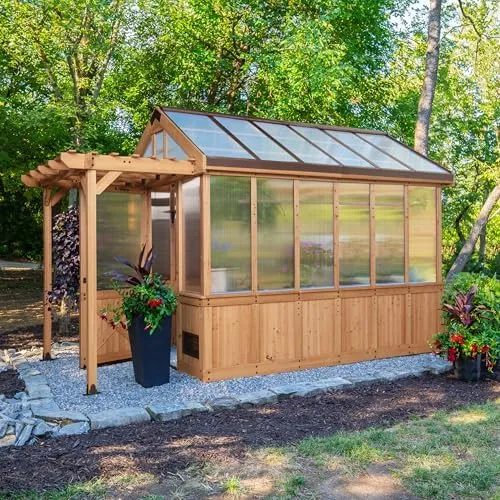
The Palram Canopia Balance Buy on Amazon is what most people picture when they imagine a “real” backyard greenhouse. It’s rated for 56 mph wind gusts and 15 lb/sq ft snow load when anchored — actual published numbers, which puts it ahead of most kits in this price range.
At $1,500–$2,400 depending on size, it’s not cheap. But the Amazon pricing (~$20/sq ft) makes it genuinely poor value compared to buying the same kit through Costco at roughly $13/sq ft. If you don’t have a Costco membership, the math shifts.
The catch that the product page won’t tell you: the panels slide into the frame from the inside. That’s listed as a feature. In practice, replacing a damaged panel requires partial disassembly of the greenhouse — “a giant pain in the butt,” in the words of one long-term owner. And the vertical walls are single-layer polycarbonate, which is a surprising oversight for a mid-range kit. Expect to add interior bubble wrap insulation if you’re in anything colder than a mild climate.
The honest summary: solid structure, frustrating to maintain, good value at Costco pricing. One reviewer who owns one said plainly: “This isn’t actually the greenhouse I would have bought if I were buying now.”
If you’re in a real climate with snow or wind and want something that lasts: Planta Sunroom

The Planta Sunroom Buy on Amazon is the recommendation for most home gardeners who’ve thought seriously about this. At $2,600–$3,500, it costs roughly twice the Palram — and fixes nearly every complaint about the Palram.
Wind rating: 65 mph (strongest among mid-range kits). Snow rating: 75 lb/sq ft (highest among kits reviewed). Polycarbonate: 6mm twin-wall, suitable for year-round cold-hardy crop growing. Panels: attached to the outside of the frame after assembly, so you can swap one out in 20 minutes without touching the rest of the structure. Ten-year warranty. Full-size doors at both ends for passive cross-ventilation.
The reviewer who compared all of these put it directly: “I really like the Planta greenhouses because they’ve got a lot of features I wish this one had, especially in terms of how sturdy they are.”
One real limitation: the base kit doesn’t include extra roof vents. If you’re in a warm climate or growing anything heat-sensitive in summer, budget for additional vents — interior temps can spike fast on a sunny 40°F day.
This is the pick for anyone in USDA zones 5–8 who wants a structure that handles real weather and doesn’t require a maintenance headache every time a panel gets dinged.
If you want to heat the greenhouse through a cold winter: Exaco Nellki Pro

The Exaco Nellki Pro Buy on Amazon at $9,000–$11,000 is not for casual gardeners. It is for people who’ve already owned a greenhouse, know exactly what they want, and have calculated the energy cost savings from superior insulation.
Triple-wall polycarbonate is the key differentiator. It’s categorically better at holding heat than twin-wall — the kind of insulation that makes a meaningful difference to a heating bill over a winter. The Exaco also includes silicon caulk seals and rubber wedge seals between panels, automated roof vents as standard, and an available $2,000 steel foundation kit (which eliminates the need to pour a custom concrete foundation — a real convenience at this price point).
The omission that’s hard to forgive at this price: no published wind or snow load ratings. For a $10,000 structure, that’s a notable gap.
Who buys this: serious winter growers in cold climates, or anyone building a heated year-round growing operation where the triple-wall insulation will pay back in reduced heating costs.
If you have a big plot and want maximum ventilation at lowest cost per square foot: Haven High Tunnel

The Haven High Tunnel Buy on Amazon is a commercial-grade structure that starts at 16x24 ft — which immediately disqualifies it for most suburban backyards. But if you have the space, the cost efficiency is real: as low as $5/sq ft at scale, full roll-up sides for ventilation, gothic arch options for snow shedding, ground posts that sink 3 ft for serious anchoring, and a 10-year storm damage warranty covering 50% of replacement parts.
The insulation is essentially zero — nighttime temps inside match outside. This is a season-extension and market-garden tool, not a winter greenhouse.
The Comparison at a Glance
| Greenhouse | Price | Wind Rating | Snow Rating | Polycarbonate | Panel Swap |
|---|---|---|---|---|---|
| Harbor Freight 10x12 | $750–$900 | None published | None published | ~4mm twin-wall | Outside (easy) |
| Palram Canopia Balance | $1,500–$2,400 | 56 mph | 15 lb/sq ft | 4mm + single-layer walls | Inside (disassemble) |
| Planta Sunroom | $2,600–$3,500 | 65 mph | 75 lb/sq ft | 6mm twin-wall | Outside (easy) |
| Exaco Nellki Pro | $9,000–$11,000 | None published | None published | Triple-wall | N/A |
| Growers Solution Hoop | $500–$1,500 | None published | None published | Single-layer poly | N/A |
| Haven High Tunnel | $1,500–$5,000+ | High (posts to 3 ft) | Gothic arch option | 6-mil poly | N/A |
The Hidden Costs Nobody Talks About Enough
Before you commit to any kit: build your real budget.
A concrete perimeter or gravel foundation runs $500–$3,000 depending on size, local labor costs, and whether you’re doing it yourself. For rigid-frame kits (everything except the hoop houses and high tunnel), a proper foundation is not optional in any climate with real wind — it’s the difference between a greenhouse and a pile of aluminum and polycarbonate scattered across your neighbor’s yard.
Extra roof vents are another near-universal add-on. Two vents sounds like plenty until a sunny spring day pushes interior temps to 85°F before noon. Budget for at least one additional vent per 8 feet of length.
And buy bigger than you think you need. This comes up in nearly every conversation among experienced growers. Whatever footprint seems right today, the version of you two years into greenhouse gardening will wish it was larger.
If You Read Nothing Else
- Season extension, warm climate, tight budget: Harbor Freight — anchored to a foundation
- Mid-range, mild climate, Costco member: Palram Canopia Balance
- Most home gardeners in real climates: Planta Sunroom — it’s the recommendation that holds up across the most scenarios
- Serious winter growing: Exaco Nellki Pro, but only if the heated-space economics work for you
- Large plot, maximum ventilation, commercial scale: Haven High Tunnel
Whatever you buy: foundation first, extra vents second, bigger-than-you-think-you-need third.