Smart Irrigation Controllers: Answer These 3 Questions Before You Buy
Some links in this article are affiliate links — we may earn a small commission if you buy, at no extra cost to you.
r/Irrigation has a reputation for brutal honesty. When someone asks for a smart controller recommendation, the top comment is almost always some version of: “Hydrawise. The only correct answer” — u/AwkwardFactor84 (31 upvotes). But read deeper, and you’ll find that Hydrawise is actually the wrong answer for a big chunk of buyers.
Here’s the thing about sprinkler controllers: this is one of those rare categories where the “best” product genuinely depends on your situation. Before you spend $150-$300 on a controller, answer three questions.
The 3 Questions That Decide Everything
1. Do you have an in-ground irrigation system, or are you working with hose-end setups?
If you’re screwing a timer onto a garden hose bib, skip straight to the Hose-End Timers section. In-ground smart controllers are a completely different product category — they wire directly into your sprinkler system’s valve wiring and require a transformer. Hose-end timers just thread onto a faucet.
2. Who’s going to manage the system — you, or an irrigation contractor?
This is the Hydrawise/Rachio fork. Professionals overwhelmingly prefer Hydrawise because it’s built for contractors: they can manage all client systems remotely, set up zones without navigating zone-by-zone, and access the controller for service without the homeowner being home. Homeowners who manage their own system tend to find Hydrawise’s interface overwhelming and prefer Rachio’s simpler app.
As u/Consistent_Growth_51 on r/Irrigation put it: “Hydrawise is not a good option [for DIY]. Their app is quite intricate and could be overwhelming, not particularly user-friendly for homeowners.”
3. Do you need full local control — no cloud dependency?
If you’re a Home Assistant power user or you just don’t trust cloud services, RainMachine is your answer and you can skip most of this article.
For In-Ground Systems: The Two That Matter
The r/Irrigation community has a clear hierarchy: Hydrawise > Rachio > everything else. That quote from u/RainH2OServices has appeared in thread after thread, and it’s a fair summary of professional consensus.
Here’s the breakdown of each.
Hunter Hydrawise — Best for Contractor-Managed Systems
The r/Irrigation subreddit treats Hydrawise like a foregone conclusion for a reason. Contractors love it because the web dashboard lets them manage all client accounts from one interface — they can run zones, check schedules, and troubleshoot remotely without requiring the homeowner to be present. For residential customers with a pro maintaining their system, this is a genuine value-add.
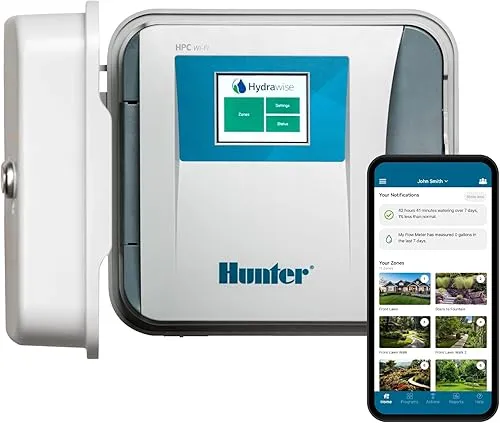
The feature set is legitimately deep: you can set zone-level schedules without navigating screen by screen, customize programs with granular controls, and view the whole system holistically. The physical unit has a touchscreen display — important for the next point.
Where it falls short: That touchscreen is small, and as u/Filo514 on r/Irrigation noted after installing both Hydrawise and Hydro-Rain units, “when you have dirty, wet fingers, it’s tedious to type in wifi passwords without one of those little touch-screen stylus pens.” If you’re a DIY homeowner who wants to occasionally adjust a schedule at the controller itself, this is annoying in practice.
There are also documented connectivity issues on Apple-optimized WiFi networks and with non-Hydro-Rain wireless rain sensors. If your home runs a modern mesh network (Eero, Google WiFi, etc.) configured for Apple compatibility, test connectivity before committing.
Pros
- Contractor-grade remote management — entire system visible in one dashboard
- Physical touchscreen on the unit
- Deep feature set for complex scheduling needs
- Consistently ranked #1 by irrigation professionals
Cons
- Touchscreen is small and hard to use with wet/dirty hands
- App complexity is a real barrier for non-technical DIY homeowners
- Connectivity issues reported on Apple-optimized and mixed 5GHz/2.4GHz networks
Best for: Homes with an irrigation company managing the system, or technically-inclined homeowners who want maximum control.
Rachio 3 — Best for DIY Homeowners
If Hydrawise is the contractor’s tool, Rachio is the homeowner’s tool — and the homeowners who use it are genuinely enthusiastic about it.
u/PsychologicalFan300, who self-installed: “I love Rachio. I was able to install this easily myself in an hour or so and the setup and interface is very intuitive. My irrigation company uses Rachio so they are able to troubleshoot, service, close my system without my even being home.”
That quote captures why Rachio works for so many people: it’s designed for a homeowner to install and understand, and it still gives your irrigation company remote access when they need it. u/Rothgar74 on r/homeautomation adds: “I’ve had a Rachio for about 4 years and it still works great. The app is awesome, the price is good, and it integrates with Home Assistant.”
The Rachio 3 specifically adds fault detection and leak detection — useful features that aren’t standard on older models. Market share is also a real factor here: Rachio has earned enough of the residential market that cloud service longevity isn’t a serious concern, unlike some smaller competitors.
The criticism from professionals (that Hydrawise is better) is real but mostly irrelevant if you’re not a contractor. For a homeowner managing their own system, Rachio’s app is the point of the product — and it’s good.
Pros
- Genuinely easy self-install (~1 hour, no irrigation experience needed)
- Intuitive app consistently praised by homeowners
- Contractor-compatible remote access for service calls
- Home Assistant integration
- Fault and leak detection on Rachio 3
- Healthy market share reduces cloud service risk
Cons
- Considered second-tier to Hydrawise by professionals
- No local control — cloud-dependent
Best for: Homeowners self-installing a smart controller and managing their own scheduling.
Head-to-Head: Hydrawise vs. Rachio 3
| Hunter Hydrawise | Rachio 3 | |
|---|---|---|
| DIY Setup | Moderate — complex app | Easy — designed for homeowners |
| Contractor Remote Access | Excellent | Good |
| Physical Interface | Small touchscreen | Basic display |
| App Complexity | High | Low |
| Home Assistant | Limited | Yes |
| Local Control | No | No |
| Best For | Pro-managed systems | DIY homeowners |
Orbit B-Hyve — Budget-Friendly, With Caveats
B-Hyve occupies an interesting spot: the professionals on r/Irrigation routinely warn against it, while some homeowners swear by it. The truth is somewhere in the middle, and the disagreement mostly comes down to customer service expectations.
u/rastapastry on r/Irrigation: “Rachio or Hydrawise for residential, and beware BHyve, because the customer service is nonexistent, and will leave you out in the woods when you need help.”
But u/basssfinatic, an irrigation contractor, pushed back: “Don’t let people steer you away from the b hyve timers… everyone… as much as we all dislike orbit. Can we agree that they have reliable basic controllers that simply refuse to die?”
The Orbit XR model specifically had a documented bug where it would get stuck in a rain delay with no path to reset — u/Comfortable_Figure17 tossed one for exactly this reason, replacing it with a Rachio. But B-Hyve broadly (not just the XR) appears to work reliably in a “set it and forget it” mode. The weather-aware scheduling works, the app is usable once you learn it, and Orbit’s size as a company means the cloud service isn’t going anywhere.
Buy B-Hyve if: You want WiFi-connected control, you’re willing to troubleshoot app issues independently, and you’re comfortable with the trade-off of saving money over Rachio in exchange for a steeper learning curve and less reliable support.
Skip B-Hyve if: You expect to need customer support, or you want an app that’s as intuitive as Rachio’s.
Pros
- Orbit’s size means cloud service longevity
- Reliable basic operation once configured
- Weather-aware scheduling works well
- “Set and forget” for low-maintenance users
Cons
- Customer service is hit-or-miss (heavily reported as hard to reach)
- App has a steep learning curve
- Orbit XR had a documented rain delay bug
- Below Hydrawise and Rachio in feature depth
RainMachine Pro — For Local Control Enthusiasts

RainMachine’s value proposition is simple: 100% local control. It connects to the internet to pull weather data but doesn’t require the cloud for core operation. If the cloud goes away, your irrigation system still works.
u/Paradox on r/homeautomation: “Big touch screen on the device, unlimited programs, really good open API, 100% local control, and a bunch of third party integrations. I was able to get it working with my Davis weather station in about 5 minutes.”
That large touchscreen is a genuine advantage over Hydrawise’s cramped display.
The complication: RainMachine has a split reputation. u/The_Great_Qbert, an irrigation professional on r/Irrigation, was blunt: “Avoid rain machine and rainbird, they are terrible, probably the worst smart controllers on the market.” Meanwhile, home automation enthusiasts who prioritize local control consistently recommend it.
The divergence is real, and worth sitting with. Professionals managing multiple systems don’t have time to deal with quirks — they want something reliable and proven. Home automation enthusiasts are more willing to configure and optimize. If you’re reading r/homeautomation, RainMachine might be right for you. If you’re reading r/Irrigation, probably not.
Pros
- 100% local control — cloud-optional
- Large physical touchscreen
- Open API with third-party integrations (Davis weather stations, etc.)
- Works with Home Assistant without cloud dependency
Cons
- Contradictory reputation between professionals (negative) and enthusiasts (positive)
- Less community validation than Rachio or Hydrawise
- Not contractor-friendly for remote management
Best for: Home automation enthusiasts who want local control and are willing to spend time configuring their system.
Rain Bird (Smart WiFi Line) — Skip It

Rain Bird is a trusted name in irrigation with decades of history. Their mechanical timers — especially the TM-2 for up to 3 zones — are legitimate workhorses. If you don’t need WiFi and just want something reliable for a simple system, u/RasCorr’s advice holds: “No wifi, go for Rainbird TM-2. Solid for 3 zones.”
But their smart WiFi controllers are a different story. u/rastapastry on r/Irrigation: “Rain Bird is a solid brand with great controllers, but the Wi-Fi smart controllers they have don’t function as well with lacking features compared to Hydrawise and Rachio.”
The smart line exists, but there’s no compelling reason to choose it over Rachio or Hydrawise. Get the TM-2 if you want a Rain Bird product; skip the smart line.
Hose-End Timers — For Renters and Simple Setups {#hose-end}
If you don’t have in-ground irrigation, the smart controller conversation doesn’t apply to you. You need a hose-end timer — a device that threads onto a spigot and controls a hose or drip line.
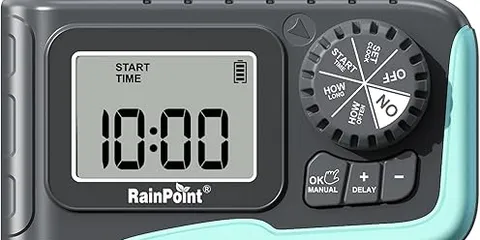
The universal finding from r/lawncare: hose-end timers have longevity issues across the board. u/indianajoe777 put it plainly: “Seems like every product from every company has the same reliability issues — only lasting one season, leaking, not shutting off, poor battery life.”
That said, Melnor stands out for one specific reason: their warranty and customer service.
u/WPWeasel: “I’ve used Melnor the last few years — I’ve got the bluetooth units going currently. I’ve also had issues with their longevity, mind you, however their warranty and customer support are excellent. They’ve been great about promptly replacing everything I’ve had an issue with, from hose nozzles to timers, with zero drama.”
u/Steinberg__ had the same experience: “I read a lot about longevity and expect to get a few seasons out of the timers then replace them.” That expectation-setting is the right frame. Buy Melnor knowing you’ll get replacement support when it eventually fails, not expecting it to last a decade.
Pros
- Multi-outlet models (4-port available) for watering multiple zones
- Excellent warranty and no-drama replacement policy
- Bluetooth and WiFi models available
- Works for renters with no in-ground system
Cons
- Longevity is genuinely limited — a few seasons is realistic
- Not a substitute for a real in-ground system long-term
What to Avoid
- Scotts Gro — startup acquired by a larger company with no irrigation market share; cloud service continuity is genuinely uncertain
- Orbit B-Hyve XR specifically — documented rain delay bug with no reset path; the broader B-Hyve line is fine
- App-only controllers with no physical display — impossible to use with wet or dirty hands
- Cheap no-brand digital hose-end timers — multiple users report single-season failure
- Any smart controller on a 5GHz-only or Apple-optimized mesh network — use a dedicated 2.4GHz network or test compatibility before buying
The Short Version
- You have a contractor managing your irrigation → Hunter Hydrawise Buy on Amazon
- You’re self-installing and want the best homeowner experience → Rachio 3 Buy on Amazon
- You want WiFi control on a budget and can troubleshoot independently → Orbit B-Hyve Buy on Amazon
- You’re a home automation enthusiast who needs local control → RainMachine Pro Buy on Amazon
- You just want a reliable no-WiFi timer for 3 zones → Rain Bird TM-2 Buy on Amazon
- You rent, or only need hose-end timers → Melnor Buy on Amazon
One last thing worth repeating from r/Irrigation: these smart controllers are not going to last 30 years like an old Hunter Pro-C mechanical unit. Set that expectation upfront. They’re consumer electronics that happen to water your lawn — plan accordingly.